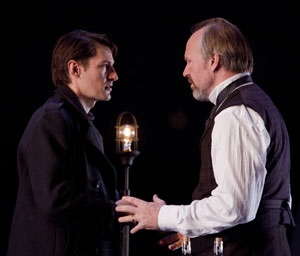
 Left - Luke Mullins and William Hurt. Cover - William Hurt and Robyn Nevin. Photos - Brett Boardman
Eugene O'Neill's Long Day's Journey Into Night is regarded as one of the great masterpieces of American playwriting. Known as an intimate portrait of O'Neill's family life, the play was handed to a publisher on a proviso that it not be published until 25 years after his death. It seemed his wish was not to be granted and subsequently was awarded the Pulitzer Prize for Drama in 1957- four years after his death.
James Tyrone (William Hurt), his wife Mary (Robyn Nevin), and sons Jamie (Todd Van Voris) and Edmund (Luke Mullins) live in an old house which is not quite a home with their apathetic summer help Cathleen (Emily Russell). They are a family consisting of adults - two unmarried sons, who are without children, and often without money who exist in the past, and in the secrets which hide inbetween their conversations. There is much said and little given away - stories, reminiscences and contexts are slowly unwound in large, sweeping monologues. James Tyrone, obsessively fretting about finances, favouring the inexpensive over "the very best" - or even the half way decent - the threat of the poor house disintegrating every decision, overwhelming any gesture of love that money could buy. When faced with a delicate ailing youngest son, an unwell wife who is to be ever-watched, and a lazy womanizing drunk eldest son - he retreats into the tobacco trance and whisky haze of his past as a successful actor.
Michael Scott-Mitchell's set, a large set of frames, treated with a dirty wall-paper finish, loom and arc over the Tyrone family. A grubby window at the back of the stage, allow us to peer into a black outside world. There is no suggestion of the surrounding land, but birds sing occasionally, suggesting life beyond the familial - the family is dwarfed by their house, overwhelmed by its presence. Complimented by this are Tess Schofield's costume designs, which hint at the era the play was written but bridges the gap between the highly stylized set and the naturalism of the text. There is an appropriateness about the three piece suit Tyrone wears, but it is subverted by the painted pin-stripes. Jamie's costume appears to be "of era" except for the shimmer in his trousers, at times suggesting, perhaps, that it is hard to know where theatre stops and reality begins?
It's a sombre and difficult play - for those who have committed themselves, or had themselves committed to life in the theatre, there are moments that sting and questions that are asked. What is the cost of artistic compromise? We see the wrestle as Tyrone wrestles with his past and his self-respect when challenged by his younger sons. We see the momentary glimpses of affection, indicating a deep love between Tyrone and Mary. We hear the regrets that have stunted the lives of them all. There is an intimacy in this disconnected family that recognises the failures and failings in each other, that apologises for ghastly blame-shifting and manipulation - but the most powerful and remarkable thing about this play is the capacity to heal.
Nevin is sweetly lost and brutally vehment as Mary, restless and empty and broken. Hurt is spectacular to watch - it's a war at times between Tyrone's stage persona and his real-life persona as it fluctuates and flips. Mullins always consistently clear - adding great dignity and intensity to the ill-fated Edmund. But truly, this is a show which lights up as soon as Russell and Van Voris enter the stage, carrying with them big hearts and unrelenting honesty.
However, Andrew Upton's direction of the actors seemed haphazard. A gratuitous move to have Edmund run through the audience's stairs was alarming and baffling - and on another occasion Cathleen enters from "the kitchen" with a message from the cook and is sent off in the opposite direction to return with the response. At times, Hurt's physical actions undercut the emotional story thus leaving Tyrone to be read as insincere or Hurt as a "bad theatre actor." Upton has assembled a brilliant team around him, there's no doubt about that - and to be in the presence of great plays, grand sets and the most skilled and celebrated in the International business is a pleasure for Sydney's audiences.
Long Day's Journey Into Night is a large and impressive production delivering performances by the most remarkable talent of our time, however, the heart of the piece never quite reaches beyond the footlights.
Sydney Theatre Company, Artists Repertory Theatre and Commonwealth Bank present
Long Day’s Journey Into Night
by Eugene O’Neill
Director Andrew Upton
Venue: Sydney Theatre, 22 Hickson Road, Walsh Bay
Dates: 29 June - 1 August 2010
Tickets: $40 - $90
Boookings: (02) 9250 1777 | sydneytheatre.com.au
Sydney Reviews
Long Day's Journey Into Night | Sydney Theatre Company
- Details
- Augusta Supple
Most read Sydney reviews
The Lark | Hey Dowling
Noni Hazlehurst brings Rose and The Lark to colourful and compelling life in this one-woman show.
Pride & Prejudice* (*sort of) | Neil Gooding Productions & Woodward Productions
This rollicking musical take on Jane Austen’s beloved novel is a side-splitting crowd pleaser.
Heartbreak Hotel | EBKM
Heartbreak Hotel invites its audience into an intimate portrait of the universal and isolating experience of heartbreak.
Current | Sydney Dance Company
While Bonachela’s work is, as always, dreamily lovely, for me the highlights were absolutely the three commissioned choreographers: Azzam Mohamed, Jenni Large and Raghav Handa.
The Gospel According to Paul – The Second Coming | Soft Tread Productions
The Gospel According to Paul is meticulously crafted entertainment. It’s uplifting without pulling any punches.
The Gospel According to Paul is meticulously crafted entertainment. It’s uplifting without pulling any punches.

While Bonachela’s work is, as always, dreamily lovely, for me the highlights were absolutely the three commissioned choreographers: Azzam Mohamed, Jenni Large and Raghav Handa.