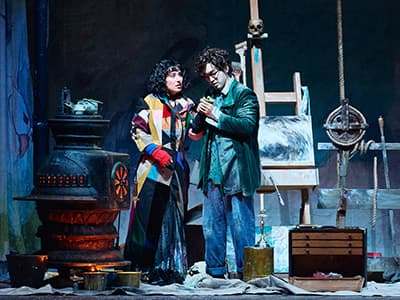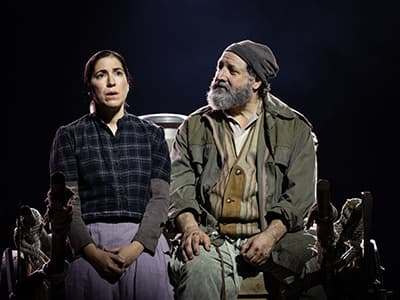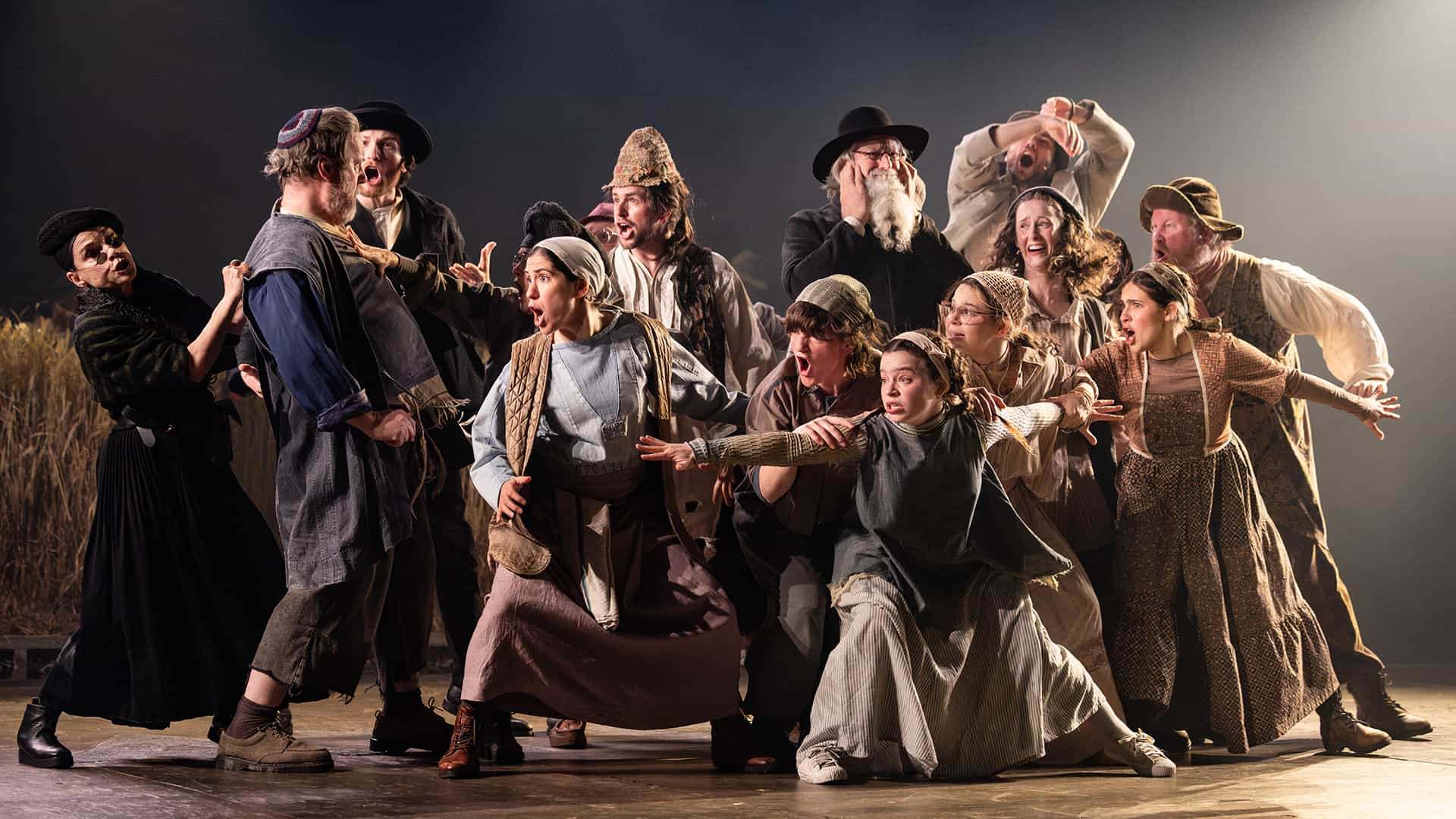
Fiddler on the Roof is set in 1905, around the fictional village of Anatevka. This is a rural outpost of Imperial Russia, far from the Tsar in Moscow or the sites of his goons’ antisemitic activities. Many of the long-established Jewish community eke out an income, living and raising their children as permitted by their customs. These build identity, and by design, difference from others. This staging gives us a generally well-produced (yet sometimes peculiar) musical view of how Anatevka’s Jews negotiate tensions with outsiders, and even their own traditions.
The musical is one of those fuzzily recalled classics (first performed in New York in 1964) that, despite its sprinkling of jaunty recognisable songs, rarely gets a local, professional staging these days. This Fiddler on the Roof is a remount of the popular The Regent’s Park Open Air Theatre production, winner of three 2025 Olivier awards including Best Musical Revival.
From characters’ early references to Kyiv, we can guess Anatevka is somewhere around modern-day Ukraine. That setting, and the supporting thread of discrimination by a powerful group towards a weaker one, make the musical’s re-emergence feel rather more related to its thematic topicality than random revival. Such topicality seems to promise further weight than that offered by the story’s main thread (one surely less controversial in modern times) of family-based conflict. Primarily this concerns Tevye the milk farmer (Troy Sussman), his wife Golde (Alexis Fishman), and their five daughters. Most crucially, the older ones, now casting an eye around the village for an appealing match, are unconvinced by the tradition of arranged marriages.
The action opens with a suspended horizontal slab that covers much of the stage, like a hovering alien craft, except it’s got “ANATEVKA” in huge (yet low-contrast) letters underneath as if it’s a faded town marker. The top surface is covered with a cereal crop. (Probably wheat.) Similar plants line the stage sides, and a further rear strip conceals the orchestra from their shoulders down. It’s an amusing way to have the musicians so close to the action yet not part of it. The stage would serve as a variety of locations thanks to minimal yet effective embellishment as required. Although, when representing Tevye’s farm, it seemed odd to have so many villagers sitting around the crop border, silently looking into the stage’s centre.
Tevye’s prologue, accompanied by a violinist (The Fiddler – Ben Adler) on that upper level, explained how his people were like the titular fiddler, having only their traditions to maintain their balance. If a viewer wondered why that metaphorical fiddler was up there to begin with, and why that actual one was on a high field and not a roof, I doubt that any tradition aside from musical fandom could have countered the resulting vertigo.
Tradition was the opening song – in which the title was exclaimed numerous times – educating us on the roles of fathers, mothers, sons, and daughters (grandparents don’t get a look-in) through lively displays by the relevant segment of the ensemble. We seem primed for an examination of how such roles will hold against modern pressures.
Regrettably the evening was subject to a number of distractions, creating various moments where our immersion in the story was lessened. This could cause us to notice some creakiness of the venerable book (written in the early 1960s) that might have otherwise been nudged out of focus by the work’s stronger elements. The cumulative result was an experience that felt thinner than I suspect it could have been.
A large slice of the action relates to Tevye, Golde, their eldest daughter Tzeitel (Freya Boltman) and her (initially secret) love interest Motel the tailor (Felix Star). Many other characters are mostly confined to being ensemble colour and movement, and so need to effectively use their limited time as distinct individuals. The hovering field tended to put faces in partial shadow (or worse) unless they were near its downstage edge. So, at least from a seat in the back third of the stalls, we had to spend a lot of effort on trying, often unsuccessfully, to discern character reactions and expressions.
Another influential technical glitch relates to Tevye’s plan to renege on the agreement brokered by Yente the matchmaker (Sigrid Thornton) to pair Tzeitel with the far-older butcher Lazar Wolf (John Waters). Tevye’s explaining of his manufactured cautionary dream to influence Golde required efforts from all villagers. As their actions and speech become feverish, it seems that we’re approaching a comedic high point. But, despite the players’ use of headset mics, the similarly febrile musicians clearly won the volume battle, leaving us only able to guess that jokes were being attempted.
With the musical magic dimming at times, an audience could notice that, oddly, the work can seem uninterested in defending the world it invites us into. Some moments are small, such as when Tevye asks Golde if she loves him, and her flat reply amounts to saying they have a history together, so that must be it. Viewed in that light, and with no other virtues given, why would a village bother to maintain the arranged marriage tradition?
Further doubts arrive as harassment from the Tsar’s men becomes more intense, creating uncertainty about the village’s future. Tevye’s throw-away line that their traditions were new once seems to be delivered rather easily. As we see the scattering of villagers quickly, and seemingly without much attachment, we could find the supposed regard for their heritage surprisingly flexible.
It might just be that Anatevka isn’t defined well enough for us to understand why its villagers behave as they do. Consequently, when we see a potential conflict resolved quickly and neatly, we aren’t merely being deprived of drama; we’re denied the satisfaction of a contest of ideas that could illuminate our characters.
Maybe ascribing contemporary resonance to this musical is unfairly saddling it with a burden it cannot consistently bear. But that only steers us to the latent question of why we are watching this work in Melbourne in 2026?
One possible answer is that, in our time of adversity, Fiddler on the Roof celebrates human connection. For example, at the wedding of Tzeitel and Motel, exuberant dancing communicates the shared joy the village takes in marriage, making this an especially memorable demonstration of community bonds. It might even cause us to envy a less-individualistic time when these bonds were so strong.
Certainly the performances held delightful moments. Boltman worked deftly as the eldest daughter seeking to carefully test the rigidity of Tevye’s adherence to cultural norms, her efforts setting an example for her sisters to follow. Star’s Motel makes us feel his devotion to Tzeitel whilst also fearing her father’s authority, giving us some useful comedic moments.
The musical spends much of its effort on Tevye, and Sussman takes that opportunity to make him a fully realised character. We could sympathise with Tevye’s grumbling to his god about his various bouts of poor fortune, with dissatisfaction never sliding into resentment. This restraint is made believable by the patriarch’s generally amiable nature, which extends to efforts to balance cultural expectations against the wishes of his eldest daughters where he can. When this balance becomes impossible, we reach a compelling dramatic climax that has the believable feel of a devout man’s crisis upon finding the limit of his flexibility.
From a musical standpoint, the musicians deliver solid renditions of soulful folk tunes that could be energetic or more plaintive as a scene required. Tevye’s 'If I Were A Rich Man' assisted our understanding of the grind of rural village life and his wish for something more comfortable. Together with Golde, 'Sunrise, Sunset', performed at the wedding of Tzeitel and Motel, gives us a satisfying view of the emotional state of parents struggling to believe how their little girl has grown and how she will now play less of a role in their lives.
Quirks aside, there is love and talent in this Fiddler on the Roof, and even though individual songs might have received patchy applause, the opening-night audience quickly offered a standing ovation. For those more enthused by musicals from the modern era, or who require a more convincing thematic through-line, your mileage may vary. Whilst likely not one of the production’s goals, one could expect that this season might stimulate some enthusiastic conversations about the purpose of a revival in 2026.
Event details
Trafalgar Theatre Productions, Regent’s Park Open Air Theatre and Brian and Dayna Lee present
Fiddler on the Roof
book Joseph Stein | lyrics Sheldon Harnick | music Jerry Bock
Director Jordan Fein
Venue: Her Majesty’s Theatre, Melbourne VIC
Dates: From 31 October 2026
Bookings: www.fiddlerontherooftour.com