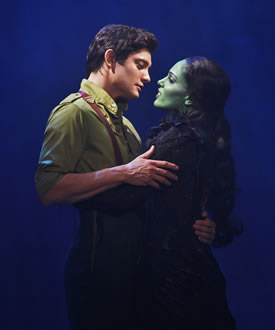
 Left - Rob Mills and Amanda Harrison. Cover - Amanda Harrison and Lucy Durack
There is a certain mix of anticipation and trepidation in approaching a show with the hype, popularity and sheer momentum that Wicked has achieved as one of the more successful new Broadway/West End musicals of recent times. All this hype aside, it is on several levels an excellent musical, filled with fascinating ideas, engaging characters and production values virtually second to none.
It is also, however, more than a little overrated.
When it is good it is very very good, but when it is bad it is… well, decidedly underwhelming. The real strength of this generally vibrant show is unquestionably its absorbing premise which – as you probably know due to the aforementioned hype – is that “so much happened before Dorothy dropped in.”
Adapted from the novel by Gregory Maguire that combines the genre of ‘parallel novels’ like Wide Sargasso Sea or Mary Reilly with the trappings of a prequel, the story is on one level simple but on another delightfully inventive. By taking the Wicked Witch of the West and Glinda the Good Witch from The Wizard of Oz, characters who were the two most diametrically opposed but in fact only sketchily motivated cyphers, Wicked provides a backstory which turns the familiar tale on its head. Providing a detailed past for characters who originally had no particular history at all and imagining that a powerful, contentious friendship originally existed between these classic adversaries is such a simple yet marvelous idea it would almost be enough to carry the show alone.
Going on to reveal the genesis of most of the major characters in The Wizard of Oz in an interlocking manner and establish a new, subversive take on the political landscape of this fantasy world is quite reminiscent of latter-day revisionist takes on superhero origins. These have proliferated in the past decade, through comic book “reboots”, popular movies like Batman Begins and, perhaps most directly, the television show Smallville, which similarly depicted future archenemies as having once been best friends. This kind of metatextual remixing of familiar pieces of popculture may seem trivial and self-indulgent to some, but for generations raised on such materials the effect can be surprisingly engaging and, at times, deeply resonant.
What makes Wicked fly higher than the mere cleverness of its premise is that it is built around two extremely engaging lead characters: the popular, prissy Glinda (initially Galinda), and the sardonic, outcast Elphaba (a pun on original Oz author L. Frank Baum), who meet at university, instantly dislike each other and then eventually become friends. With a lot of very sharp dialogue and well-drawn characterisation, these lead roles are hugely appealing and are by far the driving force of the show.
Part of what makes them, and by extension much of the story, so interesting is that they are not your typical musical roles with predictable character arcs and obvious motivations. At first you think that it is going to be a straightforward subversion of the original story’s positioning of the characters, with Elphaba as the misunderstood hero and Glinda as the bitchy, too-perfect queen bee. Then, as it goes along and the wider plot comes into focus, you may suspect that there is going to be a reversal whereby Glinda will actually step up and become a force for good while the hounded Elphaba will fall from hero to villain and, Darth Vader-like (prequels, remember?), embrace her destined role as the “wicked” witch she has been branded. But, without giving too much away… that’s not exactly what happens either.
What is engrossing is that neither character fits the good or evil binary that is cast upon them, and even from the beginning both characters are not only flawed but also surprisingly ambivalent at times, going through a series of different drives, goals and attitudes – to themselves, and to each other.
So clearly, there’s a lot to like in Wicked, which is why it’s disappointing that it doesn’t really manage to capitalise on the strong promise of the first half, which is by and large a cracking piece of musical theatre. The biggest flaw is essentially a narrative one, whereby the “prequel” phase catches up to and overlaps with the events of the original Wizard of Oz story. Where the first half had gradually built up the story and motivations as meticulously as it tantalizingly assembled the pieces Elphaba’s iconic Wicked Witch costume over the course of a whole act, it is then thrust into a rather uneven and confusing direction.
While the script playfully skirts around the familiar beats of the classic story, showing what was happening “backstage” as it were, the timeline becomes vague and extremely hurried, providing more and more origins of Oz characters in a forced and perfunctory manner and increasingly glossing over the compelling leads’ previously more nuanced motives, their relationship seeming to stall without further development. Despite the fact that most of the last third seems comprised of fairly static two-handed scenes and duets, it nevertheless all steams towards an ending that feels abrupt and even potentially confusing, leaving some of the story’s more thematically intriguing subplots about apartheid and propaganda unsatisfactorily resolved.
The plot no longer seems to clearly belong to these interesting people in whom we have become invested, they now seem to be awkwardly shoehorned into the pre-established plot rather than cleverly fitting around it with an interesting new perspective. Worse still, the story’s final resolution, in apparently a complete diversion from Maguire’s book, really comes off as a rather weak cop-out.
Given the considerable promise of the first act, or even the first two thirds of the whole show, such an underwhelming conclusion is unfortunate, and seemed like a case of failing to come up with a satisfying ending that still fit within the parameters of not contradicting the outcome of L. Frank Baum’s original.
(Speaking of which, a word of warning to any hardcore Oz geeks out there – i.e. people who even know Baum wrote 13 sequels to the original novel, let alone have actually read them – this seems strictly based on the Judy Garland movie and wholly contradicts Baum’s original continuations.)
Another complaint, and a surprisingly secondary one, is that to be perfectly honest the music and lyrics by Stephen Schwartz may leave you rather flat. They’re basically just competent modern Broadway fare with somewhat dated, ‘80s-reminiscent composition and nothing terribly noteworthy about them. The litmus test of a great musical should be that it persists in the mind and has you mumbling snatches of clever lyrics and humming the catchy tunes as you leave the theatre from a single viewing. I did not find any of the songs remotely memorable, with the significant exception of the grand showstopper at the end of Act I, Defying Gravity, a hubristic yet empowering anthem for Elphaba.
Perhaps the reason that this matters less than it frankly should is that the production as a whole is such a rich and expertly staged extravaganza with such wonderful leads that you can be easily carried away. Although sadly yet another carbon-copy import of a franchised Broadway production, the spectacle and stagecraft will certainly not disappoint, and many of the scenic effects are dazzling, not to mention the array of lavish costumes. More importantly though, the cast is very good, including former Australian Idol contestant Rob Mills, the venerable Maggie Kirkpatrick, and Bert Newton essentially reprising his role from 2002’s Nikki Webster-driven production of the original Wizard of Oz.
But the lion’s share of the credit must go to the two excellent leads. Although perhaps not the strongest singers imaginable, Amanda Harrison as Elphaba and Lucy Durack as Glinda are otherwise utterly perfect in their respective roles, with impeccable comic timing and disarming dramatic power. It is a delightful change to see a musical in which both principle roles are strong, interesting women whose conflicts do not (primarily) revolve around fighting over a man, and Durack and Harrison deserve full praise for their commanding performances.
Wicked is a flawed but highly entertaining musical with considerable appeal, as its wide success has already shown. It may not be truly one of the best Broadway shows to come along in the last decade, but it certainly has one of the most intriguing and original concepts behind it, as well as such a sense of fantasy and fun that makes it hard not to get swept along.
Wicked - The Untold Story of the Witches of Oz
Music and lyrics by Stephen Schwartz
Venue: Capitol Theatre, 13 Campbell Street, Haymarket
Dates: Now playing
Bookings: 1300 723 038 | wickedthemusical.com.au | ticketmaster.com.au