 Connecticut. Part of the so-called New England region of the eastern United States, generally associated with all things genteel. Waves of European migration have shaped its heritage and culture. It's home to the Boston accent, likely the butt of as many jokes as the Kiwi one. While inextricably bound-up with the edge of metropolitan New York, it has a distinct identity. Dick Dale & The Pixies originated there. This is the overwhelmingly Democratic milieu from which Pilobolus hails.
 Pilobolus, for reasons best-known to the company, appears to have named itself after a fungus. A phototropic zygomycete, if you must know. This may or may not be material. Pilobolus, apparently, is sun-loving and grows in barnyards and pastures. Certainly, on last night's evidence alone, Pilobolus well-and-truly deserved its place in the sun. And I imagine Connecticut is replete with barnyards and pastures.
It's Pilobolus' first time in Australia and only Sydney gets the nod. Mud in your eye, Melbourne! Pilobolus has remained one of the world's great(est) dance companies for going-on 40 years. Few, if any, would dare to contend otherwise. And those that do are probably green with envy. No wonder! For Pilobolus has managed to achieve what so few companies do, in deriving its own style. Not only that, it's not stretching a hamstring to say it's effectively devised a form of movement all its own. Much of this is based in sheer athleticism and acrobatic skill: these are bodies more rubber than human.
It all started at Dartmouth College, 1971. It was conceived and developed as a collaborative model & it's trio of artistic directors proves this not only to be possible, and sustainable, but incomparably productive. The overwhelming distinction between Pilobolus and (too) many other dance companies is its preparedness to abandon pretensions & expectations, which so often lead to work that takes itself too seriously and which has varying success in, typically, pursuing lofty, grandiose themes.
Robby Barnett, Michael Tracy and Jonathan Wolken seem to have no interest in that, For them, it appears, the pursuit of innovations and creativity in, of and from movement is more than enough. How right they are. While the company has around 25 full & part-time dancers we, presumably, were treated to the pick of the bunch, in Matt del Rosario, Jenny Mendez, Andrew Herro, Annika Sheaff, Jeffrey Huang, Jun Kuribayashi & Christopher Whitney.
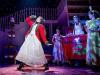
The first piece was Rushes, developed, collaboratively, just a year or two back; in this instance with Israeli choreographic team, Inbal Pinto & Avshalom Pollak. Robby Barnett was in on it, too. These three, in the truest spirit of collaboration, have let many others in on the act. Talia Beck, Otis Cook, Josie M Coyoc, Matt Kent, Renee Jaworski and Andreas Merk, for starters. It was, to begin with, their material. But the buck doesn't stop there. The glory is shared with Herro, Huang, Jaworski, Kuribayashi, Mendez, Manelich Minniefee, Edwin Olvera & Sheaff. Forget the power of one. This is proof positive of the power of the collective. All dancers (with the exception of Kuribayashi, who takes turns with del Rosario for the following, solo piece) were on stage, when the curtain rose, preceded by some boisterous carnival music. It's described as an 'isolated community of broken dreams'. Mmm. Inasmuch as Pilobolus relies on narrative, what I saw, as the central motif and metaphor, was a clock, defined by a large, circular, orange plastic sheet and twelve chairs, used optimally, as 'props', dancing partners and to evoke the notion of large, awkward, encumbered creatures (which pervades other works). Here was the waiting-room of existence, in all its poignancy, sadness, hopelessness and comic character.
There is real equality between male and female dancers: it's nothing to see one of the latter wield one of the former, something one's only likely to see in ballet rarely, methinks. And not much more often in modern dance companies.
Pilobolus seems to conform to its highly admirable selections of music very faithfully, expressing a reverence for such. And why wouldn't it? It utilises everything from the inventive arrangements of Eddie Sauter (one of the swing era's most interesting and out-there orchestrators), to Miles Davis, Brian Eno and Talking Heads. It also seems to heavily favour performances by the Kronos Quartet. All these flavours meld beautifully; with flawless relativity.
With Rushes, reference is made to both the French master of comedy, Jacques Tati and the Russina humourist, Nikolai Gogol. I can't vouch for the latter, but Rushes has captured the same essence as Tati: it seems to come from the very same headspace (and heartspace); walking the precarious line between tragedy and comedy, with its overlaps and coincidences, delicately and divinely. The result is a moving, sympathetic work, which shows a profound depth of understanding of the human condition; more than that, it points to the universality of our experiences. Beyond the gentle genius of Tati, there is something owed to vaudeville and Anglo-American clowns, like Chaplin & Lloyd: a similarly affectionate approach to characters created.
Pseudopodia, choreographed by Jon Wolken, is something else again and harks all the way back to 1973. Age hasn't wearied it. It's vital; invigorated. With a percussive score by same, and Moses Pendleton, mood-setting lighting by Neil Peter Jampolis (Yoann Tivoli's lighting, for Rushes, was an enhancement, also), Jun Kuribayashi gives a lesson in just how pliable a male body can be, in his tribute to tumbleweed. In it, we can marvel at the aimless, enviable freedom of such and meditate upon how we might incorporate something of its windblown, 'go with the flow' aesthetic in our own lives. Such simplicity and, through it, such depth, focus & solidarity of purpose. Gasp!
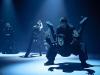
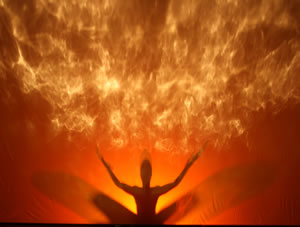
Darkness & Light is a recent work, by Basil Twist (a puppeteer), Robby Barnett & Jonathan Wolken, with other collaborators too numerous to name. Again, the shared vision and ownership is a challenge to the benevolent dictatorships of sundry artistic directors, over a good many years. It shows just how successful a cooperative model can be: after all, Pilobolus has survived, prospered and endured. The piece is literal, inasmuch as it plays with lighting, a large screen and shadow, to bend the familiar into the alien; to morph one being, or thing into another; to evoke the natural, supernatural, cellular and electric. It brought the whole of the touring company onstage to deliver something unconventional, bold and brilliant!
Symbiosis (Michael Tracy, with Otis Cook and Renee Jaworski) sees Jenny Mendez and Jeff Huang in a duet. Huang is a tree, bending to envelop the uncertain figure below, in a reassuring embrace. It's heartrending; romantic; moving. Don't be surprised if you're inexplicably drawn to tears. At particular moments, Huang's strength is so deceptive as to trick the eye into believing what the heart longs to: that Mendez is floating on air, borne aloft by love alone. Blissful.
Finally, comes the animalistic primitivism of Day Two, from 1980, directed by Pendleton and choreographed by Daniel Ezralow, Robert Faust, Jamey Hampton, Carol Parker, Mo Pendleton. Peter Pucci, Cynthia Quinn and Michael Tracy. I mention all these names (while leaving a lot of contributors out) as they should serve as recommendations, in themselves, where or whenever you run into them. It's the second day of creation and life is swinging, vigorously, into action. From things that hop, through all things odd, to birds and beyond. It's the Origin of Species, in abridged, visceral form. And, oh God, it's good!
What's resplendently inveigling about Pilobolus is the fact that whether you're a dancer, choreographer, have two left feet, are well-versed, or a complete novice, you can hardly fail to be in awe of its output, which is diverse and utterly original. The word derivative never applies. Homage doesn't spring to mind. Big ideas are subservient to the sheer, breathtaking, fleshly sensuality of bodies. The magnificence of movement. This is reaffirmed during the curtain-calls, which see the dancers sliding & tumbling across the floor, on water. Playful. Inspirational. Sensational. Hallelujah!
Andrew Kay & Associates presents
PILOBOLUS
Venue: Sydney Theatre, Walsh Bay
Dates: 5 – 17 May (Tue -Sat 7.30pm (excluding Tues 12 May, 6.30pm, Sat Matinee 2pm, Sunday matinee 3pm)
Tickets: $74 - $109
Bookings: 02 9250 1999 www.sydneytheatre.org.au | Ticketek 132 849 www.ticketek.com.au