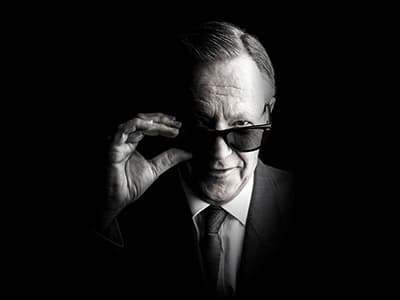
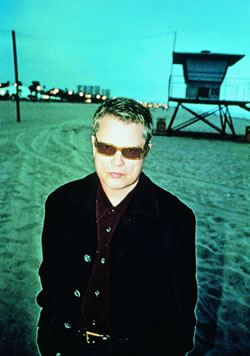
 Left - Charlie Haden. Photo - Thomas Dorn
Born in the heartland (Shenandoah, Iowa), Charlie Haden began his musical life as a singer. At the unbelievably tender age of 22 months. He wasn't crooning a jazz standard. But C & W, on his parents' radio show. Happily, somewhere in his early teenagehood, he took up bass. Later, he fell into jazz, more or less, on his move to LA, circa '57. And he fell in with precisely the right crowd. The likes of Art Pepper, Dexter Gordon and others. from that moment, it seems, his fate & future as a legend of jazz was sealed. In the year of our Lloyd (that's me), 1959, he teamed with Ornette Coleman and the rest, as the cliche goes, is history. It was Coleman's seminal quartet, also featuring drummer, Billy Higgins, and Don Cherry, on trumpet. Influential; much talked about; lauded; revered.
For an ordinary man, this would've been enough to dine out for the rest of his natural life, even if it had been a fleeting affair. But at the same time, Haden got it on with 'trane(!), Shepp, Jarrett and Metheny. Since, he's practically never done anything uninteresting, or less than spellbinding. Instrumentalist (the best in the biz); composer; arranger; political activist. He's among the rarefied few, if you're a jazz musician, you probably publicly love & privately hate.
Over the years, he's added Joe Henderson, Chet Baker, Stan Getz, Herbie Hancock, Hank Jones, Dewey Redman, Paul Motian, Jack DeJohnette, Kenny Barron, Michael Brecker & David Sanborn to his list of collaborations. And that's by no means an exhaustive resume.
From a musicological and sociopolitical standpoint, it was most probably Haden's 1969 joining forces with pianist & fellow composer Carla Bley, to found the Liberation Music Orchestra, that was his most poignant career pinnacle. The group’s self-titled debut is an undisputed touchstone of contemporary music, marrying experimental big band jazz with folk songs of the Spanish Civil War, to create a powerful, deeply moving, original opus.
Haden established jazz studies at California Institute of the Arts in 1982, ensuring his inestimable legacy is available to succeeding generations. He wears more badges of honour than a five-star general: the Los Angeles Jazz Society prize for Educator of the Year; countless guernseys in Downbeat readers' and critics' polls; a Guggenheim fellowship; grants for composition; France’s Grand Prix Du Disque (Charles Cros) Award; Japan’s SWING Journal's Gold, Silver & Bronze awards; Montreal Jazz Festival’s Miles Davis Award; you know the tune.
The coolly autumnal Sydney evening of Thursday last saw him take the stage, for the first time in about 30 years, for one show only, in the concert hall of the Jorn, in the guise of his Quartet West, comprising Stevie Wonder's saxman, Ernie Watts, drummer, Rodney Green, and piano-man, Larry Goldings.
Anyone chosen to play in this company is blessed and it was Sydney guitar'whizz't, James Muller, who got the prestigious nod. He, too, has racked-up a daunting list of cred, through outings with James Morrison, Mike Nock, Dale Barlow, Bernie McGann & Mark Isaacs: I could go on, but you get it, a veritable who's who of Aussie jazz. He cites VB as a primary influence and his sometimes dreamy, liquid adventures, such as Lucky, Lucky might be a pointer to this. If so, I'd be the first to shout him a six-pack. There's a resonant, reverberant, amplified crossover edge to his style, counterpointed by the kind of smooth, sweet technique one might associate, locally at least, with the great man, that veritable godhead of guitar, George Golla.
Of course, he's proved equally at home in the prestigious (downright legendary, actually) company of Chad Wackerman, Bill Stewart, Vinnie Colaiuta and Matt Pendman. (His latest album, Kaboom, was recorded in NYC and is reputed to realise all the explosive promise of its title.)
Awards must be veritably tumbling from his mantle: he's a winner of the National Jazz Awards (Wangaratta); has two Mos (for best jazz instrumentalist and best jazz group); Arias, for best jazz album; an APRA and (2004) Freedman Fellowship. But perhaps it's his hero John Scofield's ringing endorsements that transcend all: for instance, saying Kaboom blew him away. Those who've seen a duel between master and disciple have been quick to confirm Muller's surefooted acquittal and equal footing. All this, with no signs of a single grey hair.
The mild-mannered boy from Adelaide trotted out his trio (he has more than one band with his own name on it, and plays in numerous others), on the night including Tim Firth, on drums, & Brett Hirst, on bass. Hirst seemed to be giving everything in him, as if keenly aware the great man was watching, in the wings, or green room. It made for an especially compelling performance of acrobatic proportions. Firth, meanwhile, played with commendable subtlety, that and his distinctive solos serving as ample evidence of both his technical mastery and musicality.
They played three pieces, beginning with Sean Wayland's Honeycombs, followed by Muller's own Country Suit and another of Wayland's, Australian Rhythm Changes. The last might've become a classic, but I need more time with it: I found its stark, jagged transitions rather jarring. Honeycombs is a tune of an entirely different colour, and flavour, driving along at a lazy Sunday afternoon pace, with a rhythmic bed providing a supple, supportive suspension for Muller's clear-as-a-bell cascades (to say his playing is fluid just doesn't cover it). For Honeycombs, he favours a slightly gritty edge to the sound. Nonetheless, the notes run like honey, from a spoon, much in keeping with the momentum of the composition. My companion much-favoured Muller's own Country Suit, which interpolates a laidback country blues sound with profound panache.
If you revere superlative guitar, you'll find easy adulation for JM & his 3. Indeed, racking my brain yields no cautionary note in joining the chorus of critics who've declared Muller unequivocally worldclass, if not world-beating. What sits on the page as mere hyperbole is borne, energetically, into the ether, in the live context.
Ernie Watts was the first of Haden's Quartet West onstage, albeit unofficially, apparently consulting with the sound engineer, as if it was just another gig. His ease & nonchalance, throughout, made his incomparable soloing all the more breathtaking. And when I say breathtaking, I'm sure my ears didn't lie: there were audible gasps aplenty, at the conclusion more than one of his extended excursions on sax. Even in light of the gloriously idiosyncratic stylings of Goldings and Haden (and I haven't even mentioned Green yet), I'm quite sure many would've wended their ways homeward enthusing about Watts.
Could anyone put it better than Kirk Silsbee, writing in LA CityBeat? “The virtues we’ve come to associate with Watts include fertile harmonic imagination, a beautiful Trane-soaked-in-wine tone, the blowtorch cry, rippling cadenzas and the ability to swing at any tempo.” Unless it's People Magazine. "The celebrated young lions of jazz may have daunting power and speed, but few of them have what tenor saxophonist Watts has honed to perfection: phrasing as natural as falling water and a sound at once steeped in tradition and wholly unique."
Individually and collectively, QW comprises players who can't help but indelibly stamp their signatures upon any song.
Haden is by no means showy, or showman. While he brings his personality to bear, his playing is all about the pieces, not the instrument, his own status, or virtuosity, as such. This, no doubt, is what has distinguished him as a true and enduring jazz giant: the stuff of legend. His capacity for restraint, nuance, resonance (warmth & depth) and melodicism knows no bounds, nor any peer, to my knowledge or awareness. Moreover, he's just as at home with the open-endedness of free jazz (which he helped Ornette Colman launch, in the 60s), as with a more conventionally structured standard. No doubt this has abetted his scope: no genre seems out of his reach, whether it be world, folk, film, gospel, avant-garde, ensemble, big band, or anything else. He cares not for boxes, boundaries, labels, or straightjackets.
He's won or been nominated for more Grammies than you can poke a bow at; even QW, formed in '86, has been nominated. Haden's original and steadfast vision, mission & aspiration for QW was and has remained to colour-in the lost ambience of the '40s and the golden, olden days of Hollywood. This means they invest as richly in luxuriant arrangements of popular, bygone ballads as in the languid atmosphere of their original, postwar bop.
All, and each, seems utterly self-possessed in achieving this. There seems to be an unspoken connection between them which might be compared to a spider's web: it can barely be glimpsed, yet this invisibility belies an immensely & surprisingly disproportionate strength of purpose and camaraderie.
Goldings, like Haden & Watts, couldn't give a tinker's for 'file under' convenience. Just as Haden has, for example, teamed with Brazilian guitarist, Egberto Gismonti, Argentinian bandoneon afficionado, Dino Saluzzi, or a host of others, and Watts hasn't baulked at playing with Zappa, Goldings has no pretensions about segueing into funk, pop, electronic, film (for example, Clint Eastwood's Space Cowboys and John Madden's Proof) or alternative music. He, too, has worked with Bley & Brecker, as well as DeJohnette, Jim Hall, Jon Hendricks, Pat Metheny, Maceo Parker, Madeleine Peyroux, John Pizzarelli, Curtis Stigers, John Scofield and James Taylor. He's made 10 albums in his own name & scored the odd Grammy gong, too. In his QW suit, he put me very much in mind of the young Gershwin, with a very classically-influenced penchant in his soloing, which proved utterly sublime
Rodney Green, succeeding Larance Marable, when just 19, was favoured by the ascendant Diana Krall. Now, at 28, he's a veteran, with his very own who's who cv (again, with some notable collaborators in common): Terence Blanchard; Stephon Harris; Wynton Marsalis; Ravi Coltrane; Christian McBride; Joe Henderson; George Benson; Nicholas Payton; Michael Brecker; Kenny Baron; Abby Lincoln; Betty Carter; Wycliffe Gordon; Herbie Hancock; Dianne Reeves; et al. His style is reinvented old-school: think (Philly) Joe Jones, or Danny Barcelona. It's refreshing and invigorating!
I'm sure I speak for much of the assembled in asserting many of us could've stayed all night, listening to what was and is, above all, classic American music. Of all the pieces played, perhaps First Song (for Ruth) was the most affecting: an unabashedly romantic tribute to Haden's wife. This wasn't, and isn't, mere music. It's audible therapy, sure to soothe the savage beast, so easily provoked and unleashed, in all of us.
Haden hasn't been here since playing the Footbridge Theatre in, I think, 1989. he's promised to return, in much shorter order, no doubt encouraged by the reverence afforded via, as far as my eye could see, a unanimous standing ovation.
NB. The only caveat on the performance was a largely insurmountable technical one: in such a grand hall, not necessarily known for its superlative acoustics, too much nuance went astray, with little of the colours of the instruments reaching one's ears. The mix, too was questionable, with Haden's already subtle bass relegated very much to the background, while Green's snare-drum, especially, was often too loud, giving the (false) impression he's a hamfisted player. Is there an engineer in the house?
Charlie Haden Quartet West
With James Muller Trio
Venue: Sydney Opera House
Date/Time: 8pm Thu 30 Apr
Tickets: $49.00 - $110.00
Bookings: 02 9250 7777