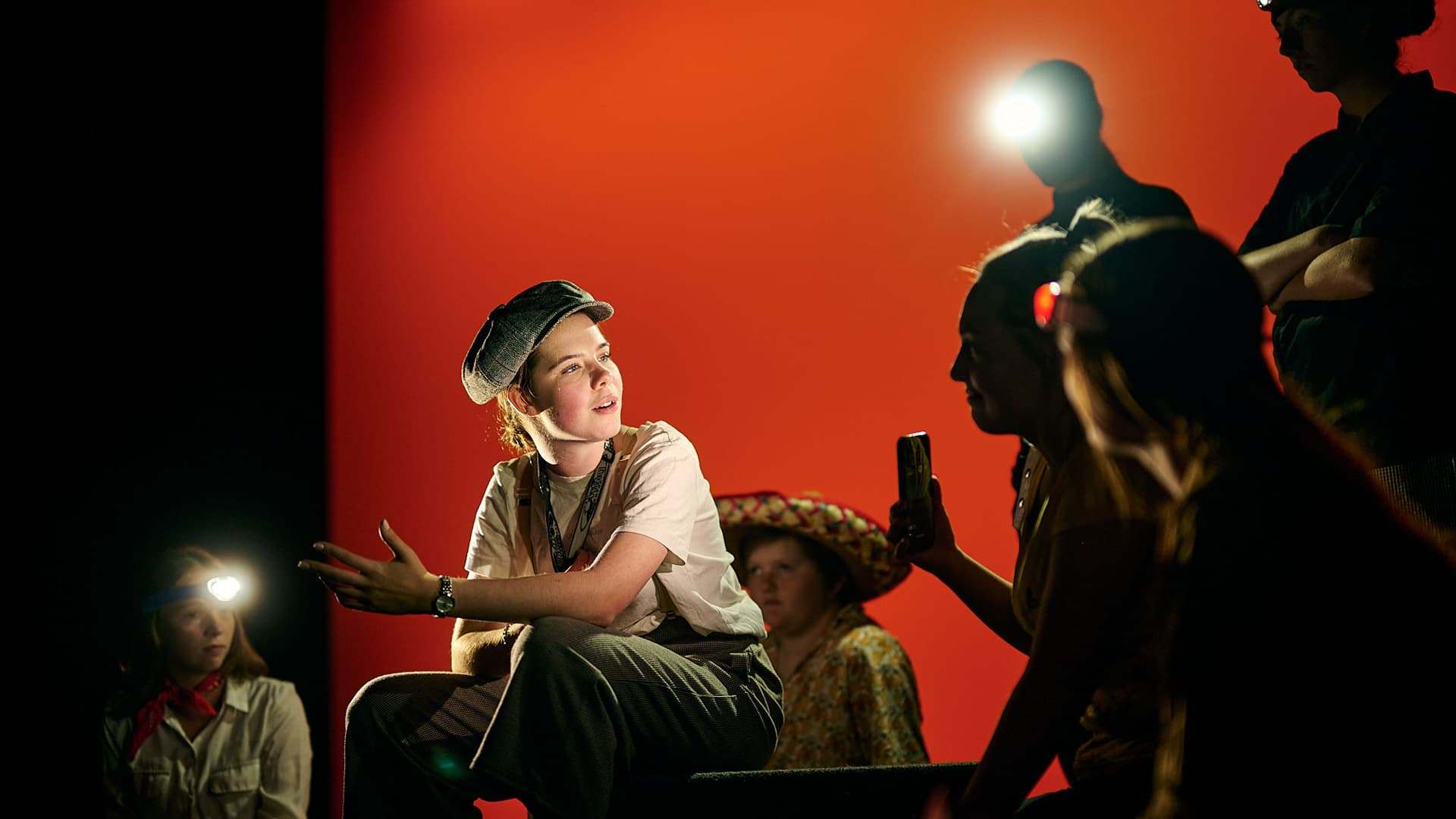
There are some assignments that arrive through rigorous editorial pitching.
And then there are some that arrive because your teenager says, you’re coming, and suddenly you find yourself sitting in Canberra Theatre Centre preparing to watch three hours of original theatre devised by Year 7–12 students and wondering quietly whether your lower back is up to the task.
Yes, it feels faintly ridiculous to be writing about a school showcase for Australian Stage.
But perhaps that’s exactly the point.
Because where else do we look to see what performance is becoming?
ACT UP! brings hundreds of students together each year to make original work. Not polished work. Not professional work. Work.
And Canberra, for all its frustrations, has quietly become a city unusually committed to young artists.
You can trace lines through the city.
Leena Wall and Fresh Funk teaching generations of young dancers to take up space. Alice Lee Holland and the team at QL2 creating rigorous contemporary dance pathways. Luke Rogers and Canberra Youth Theatre continuing to treat young people as artists rather than audiences-in-training. Chip Lo and Project Beats bringing young people into public space - creating crews, battles and street stages where performance belongs to everyone, not just those who already think they’re artists. Ali Clinch continuing to make spaces where emerging performers are taken seriously. I could go on.
Together, these artists and organisations form an ecosystem that allows young people to take creative risks long before anyone is paying them to do so.
They are joined by another group who rarely receive enough recognition: drama teachers.
ACT UP! is a testament to their work. The teachers who stay back after school, fight for rehearsal time, encourage shy students to step forward and confident students to listen.
Thank goodness some schools are still prioritising drama.
Because drama is never just about theatre.
It helps young people find their voice, literally and figuratively. It gives them permission to be seen. To imagine. To connect. To play.
And lordy knows we need more of that.
At a time when so many young people are struggling, it is easy to forget that belonging can begin with something as simple as being handed a script, a rehearsal room, a chance to speak and some solid eye contact.
ACT UP! is also a reminder of the care that sits behind these opportunities. Canberra Theatre Centre's School Liaison and Workshops Officer, Jena Prince, is one of the people quietly making sure young artists can take risks safely. When my own fallen hero emerged from the stage nursing bruises and wounded pride, Jena was standing by with an ice pack and snacks. It was a small gesture, but one that spoke volumes about the culture of care underpinning the program.
Which brings me to my child.
The first performer of the night.
And within moments, they fell arse over tit.
A proper fall. On a very big stage. In front of a full audience.
As a parent, my stomach dropped. As someone who has worked in performance for decades, I knew immediately what mattered wasn't the fall. It was what happened next.
They got up. Reset. Continued.
And I was so proud of them.
Not because they pretended it hadn't happened. Not because they turned it into some triumphant theatrical moment. But because they did what performers do.
They kept going.
Later I realised that may actually be one of the most valuable things young performers can learn. Not how to avoid mistakes, but how to recover from them. How to stay present when something unexpected happens. How to discover that audiences are not actually asking for perfection. They are asking you to keep going.
That feeling appeared throughout ACT UP!. Young people attempting difficult things. Work that sometimes reached beyond itself. Moments that didn't land. Moments that absolutely did. Performers taking risks in front of hundreds of people and discovering that they survived.
One of the pieces that stayed with me was The Awakening by Dickson College. The work reached ambitiously towards questions of identity, friendship and the uncertainty of standing on the edge of adulthood.
Within it, Olive Ferguson delivered one of the strongest performances of the evening. Powerful and quiet - which is harder than powerful and loud. There was confidence in her restraint and a refusal to over-perform. In a room full of performers eager to be seen, Olive understood the value of stillness.
St Francis Xavier's Another Tuesday? was among the most formally playful works of the evening. Inventive, physical and ambitious, it created a theatrical world populated by talking creatures and environmental commentary. (Though I was reluctantly reminded of the agony of “being an animal” in high school drama class).
Interestingly, it was also the only work where I often felt adult thinking pressing through student voice. There were moments where teenagers seemed spoken about rather than spoken from – viewed almost as distant creatures rather than allowed to inhabit their own ideas. Even so, the ensemble remained committed to the world they had created, and Yvaine Moyle stood out for her grounded presence and ease within the physical language of the piece.
Gold Creek Secondary School's In Loving Memory Of… trusted something many professional companies still struggle to achieve: ensemble.
Kate Chantaruji, Adie Grealy, Evie Grealy, Felix Haines, Annabel McNicholas and Sabine Reiter all felt like performers of genuine promise. Every performer had star quality, yet the real achievement of the work was the way they functioned together. There was generosity in the performance, a sense that each actor was elevating the others rather than competing for attention.
The result was unexpectedly moving.
Honestly, they should consider continuing as a group. Not because school friendships last forever, but because there was already something there that some companies spend years trying to manufacture: trust.
A Corporate Storm from St Edmund's College brought a welcome dose of theatrical excess to the evening. Its AI-fuelled corporate satire tackled questions of automation, power and human connection with confidence and humour.
Particularly memorable was Lincoln Moore as ARIEL, who brought physical precision and commitment to a role that could easily have become a caricature but instead felt genuinely theatrical.
What ACT UP! offers is not simply a showcase of emerging talent. It is a rehearsal for becoming. Across Canberra, organisations such as Fresh Funk, QL2, Canberra Youth Theatre, Project Beats and countless independent artists are creating opportunities for young people to take creative risks long before anyone is paying them to do so.
And that matters.
Because somewhere inside dance studios, rehearsal rooms, youth theatres, school halls and even on the stage of Canberra Theatre Centre, young artists are learning that the work is not to avoid falling. The work is to discover that getting up again is part of the art.