Simon Stone’s play, The Cherry Orchard is a modern re-working of Chekhov’s play of the same name, perhaps comparable to Bernstein’s re-working of Romeo and Juliet in West Side Story. It is set in modern South Korea, currently of course a hotbed of new directions in the arts.
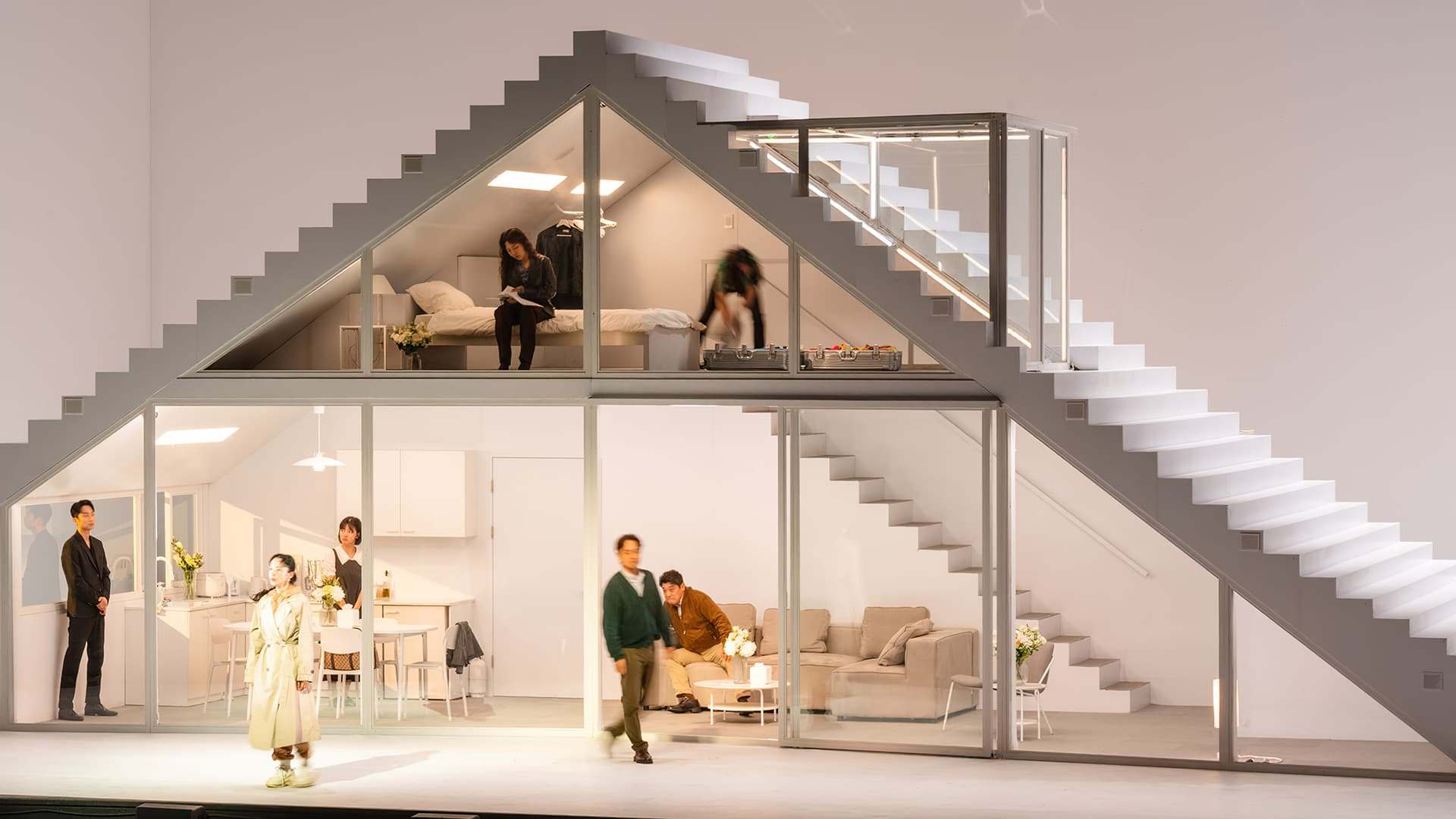
The story follows Chekhov quite closely, even to the extent of having the Cherry Orchard itself as the symbol of beauty being destroyed by materialistic progress. The cast is predominantly Korean, and the language is also Korean. They are brilliantly directed by Stone, on a set which is one of his trademarks, a cut-away several-storey house. The acting, particularly by the two protagonists, Haesoo Park as Doosik and Doyeon Jeon as Doyoung, is on a very high level in terms of expressive delivery, and always compelling.
The language created a few problems, however, even with surtitles. The play is heavily dialogue-based, and contains many passages where the dialogue goes at breakneck speed. Of course the surtitles are essential, but flashing one’s eyes up and down far more frequently than, say, in opera, created considerable strain at times.
This was compounded by exigencies of the theatre itself. The Adelaide Festival Theatre was designed for concerts and opera, and is very much too big for plays. So the actors in this show were all miked. While the volume of this was very discreet, it had the effect that the sound of every actor arrived at the ears of the audience from the same place, so that one couldn’t tell who was speaking at first. This was particularly true of the female actors, whose voices were more similar to each other than those of their male counterparts.
That said, there were passages of complete involvement, especially surrounding the scenes where the vile capitalist Doosik sets about buying and then destroying the home of the family who own the cherry orchard. Yet I was left with some serious questions about the place of Stone’s play in our world.
By transposing Chekhov’s play from late 19th century Russia to present-day South Korea, I presume he wanted to say that nothing has changed – that what Chekhov talked about is still current. It is a commonplace that directors transpose classical plays, especially Shakespeare and the Greek tragedies, to more modern settings; or perhaps, like Bernstein or Benjamin Britten and others, turn them into operas. The success of these transpositions depends to a large extent on how general, or even ‘universal’, the values and situations bodied forth in the original appear. I do not find the values and situations of Chekhov’s play to be general in this way, but much more rooted in the state of Russia in the declining years of the Tsars.
Another question, one that is touched on in an interview with Stone printed in the program, but not clarified, is this: to what extent did Stone write this play at all? He doesn’t speak Korean. There is no mention of Russian, the language in which of course Chekhov’s play was written. So there is a multiple translation involved. And I have to disagree with Stone’s point of view about ‘so-called cultural difference’. In my understanding, not only do different cultures evolve significantly different ways of managing human interaction, but different languages evolve different ways of communicating. Every translator knows that exact translation is impossible.
And then there is the question of the genre writ large. In our post-Artaudian era of theatre, where the stage has been a locus of works that cannot be transposed into other mediums (such as all forms of physical theatre, for example), to write a new play that is so dependent on its text that it could as well be read, seems anachronistic, almost solipsistic in fact. So for me Stone’s re-working of Chekhov had as many disadvantages as advantages. As a director, I take my hat off to him. I am much less convinced by his ideas and processes as a writer.
Event details
LG Arts Center presents
The Cherry Orchard
by Simon Stone | Anton Chekhov
Director Simon Stone
Venue: Festival Theatre | Adelaide Festival Centre SA
Dates: 21 February – 1 March 2026
Bookings: www.adelaidefestival.com.au
Co-commissioned with Adelaide Festival
Performed in Korean with English surtitles