We can thank Donald Horne's 1964 book “The Lucky Country”, for an enduringly popular term used to describe Australia. Well, misused is generally more appropriate – the author didn’t mean it as a compliment. The musical The Lucky Country sides mostly with the optimists, even though a less deferential view seems justified, and more able to provide fresh insight.
This musical outing has music and lyrics by Vidya Makan, with music direction and orchestration by Heidi Maguire. A sneak peak of one song, “Hugh Jackman”, at the Melbourne Fringe Gala was a strong advertisement for the show. Cast in an Eastern action film, hoping to meet the handsome and famous headliner, an Indian-Australian actress (Makan) must pretend to conduct a ceremony, but she doesn't speak any Hindi. The attempt to “style it out”, and the trans-national blowback to follow from this novel situation were amusing, and set up some anticipation for, and expectations of, the entire work.
However, we were led to expect more than comedy, with the Fringe blurb advising that the show “digs deep into the themes of identity and belonging”. Notes from director and co-creator Sonya Suares in the programme further outlined the show’s ambitions to engage with some of our nation’s complexities, including “the trauma at the heart and foundation of Australia.”
Even given that this is a musical, there is often very little dialog, with 13 songs crammed into the hour, each with a short story to tell. This seemed to limit the scrutiny applied to aspects of modern Australia.
It was unfortunate that, fairly often, vocals were unable to cut through the musical backing. Consistently straining to hear lines, especially as they became weaker towards their ends, became hard work. This surely prevented some of the audience from appreciating a decent number of lyrics.
When the show attempted dramatic scenes, they tended to show a distracting artificiality or vagueness. From what we know of the stoicism of Australian war veterans, there didn’t seem to be a clear motivation for an elderly vet to expound on war’s horrors.
Another tale of Kylie the schoolgirl with her love of Kylie Minogue and chai (played by Makan, so intending to indicate South-Asian heritage?), has a violent end, but no motive is even sketched. Maybe this is an attempt to recall recentish history, say a period around 2009 where there was a spike in the number of Indian students being attacked in Melbourne and Sydney. Police found evidence of bigotry in some of those crimes, but this work seems unwilling to make any statement.
Other less-than-credible scenes in 2025 include one where a teacher (Naarah) stands by whilst an indigenous student (Garret Lyon) is bullied by a white classmate, with the former the one encouraged to leave the lesson.
The work seems more assured when pursuing comedic situations, but results could be variable. A scene where two gay men (Jeffrey Liu (JËVA) and Karlis Zaid) at an AFLW game wonder if they can maintain a blokey façade for the other is amusing. However, the background action, say where an umpire turns away from the play to make a horrified face at us, could slant towards cartoonish humour.
Other material, even if well-performed, could feel to be treading somewhat familiar ground. Despite our knowledge of the perils of Australian fauna, Phoenix Jackson Mendoza gives a suitably killer performance as our dangerous continent, also showing off a glamourous example of Emily Collett’s costume design.
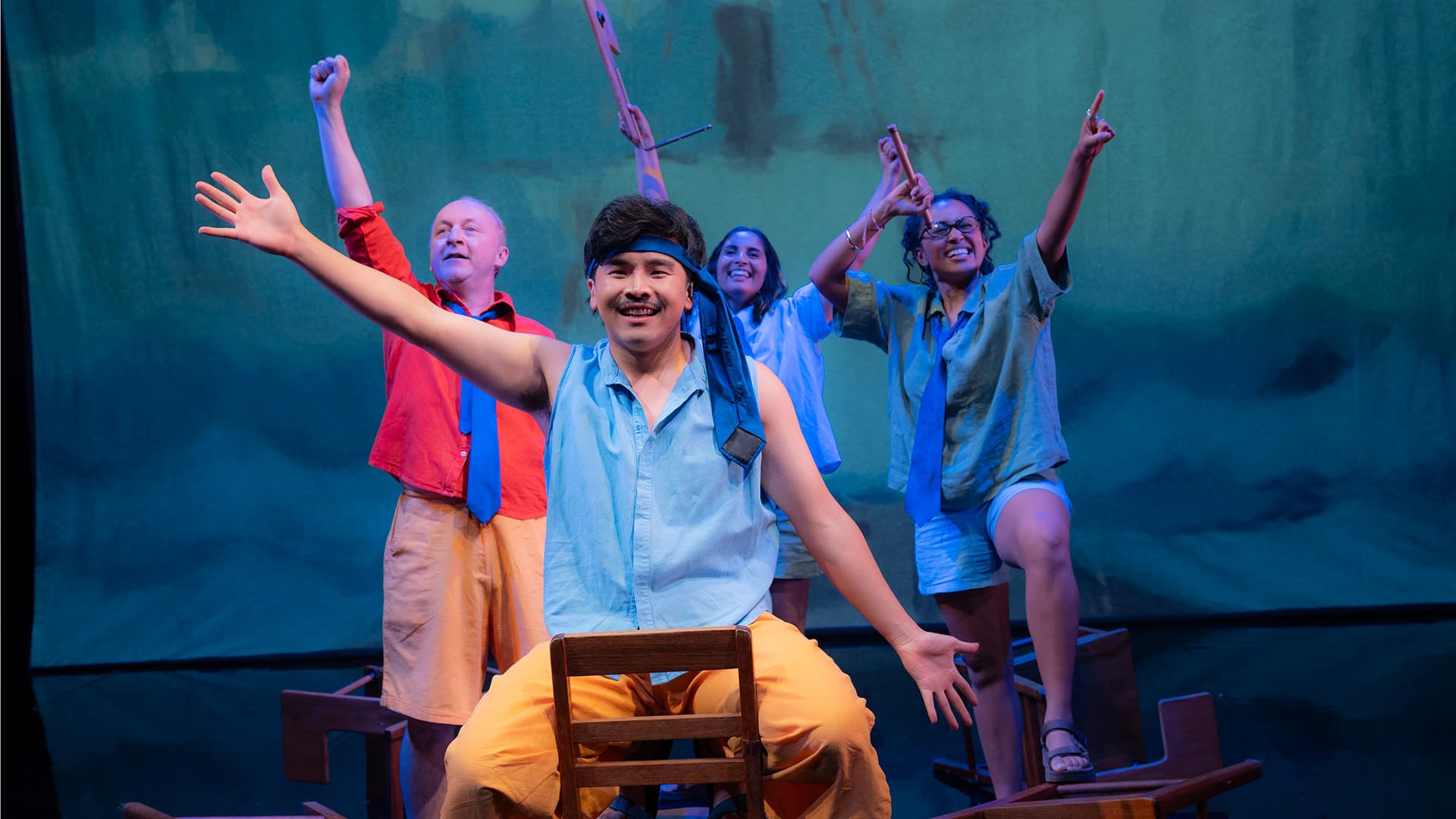
We did get some moments of genuine, more novel insight. “Growing a garden” briskly traced the history of a young girl (youthful exuberance convincingly rendered by Mendoza) hoping for a comfort of her original land in her adopted country. This bright performance travelled from domestic familiarity, to the uncertainty of being a refugee, rising to an anticipation of what a safe new home could offer. The gleeful joining in of the whole colourfully dressed cast (assisted by Amy Zhang’s choreography) was an especially good example of the work’s lighter moments that could have effectively balanced darker content.
Also notable is a scene where a schoolboy (Garret) celebrates Baker Boy winning Young Australian of the Year, maybe expecting that this will start an era of more acknowledgement of the contributions of Indigenous Australians to our culture. It was nice to see some recognition that we can have aspirations to bigger things than, say, living in Byron Bay.
Melbourne Fringe gives us a particular opportunity to hear from a range of voices, including from people of colour. In 2023, musical comedy duo The Coconuts (Leela Varghese and Shabana Azeez) referred to how some male comedians would try to undermine their contributions. At this Fringe, Lilikoi Chaos, of Pasifika heritage, had some stories about men’s fake feminism, feeling pressure to act more “white”, and an especially shocking tale of overt racism towards women in Queensland’s health sector in the 1980s.
By comparison, The Lucky Country seemed quite reluctant to make us have uncomfortable thoughts for very long at all. But the arts could play a role in making us think a bit more deeply about how our nation is travelling. Maybe not so well, according to recent news. We can read of neo-nazis bringing violence to Melbourne streets and targeting Indigenous sites. Or of polling that shows One Nation’s support might now exceed that of the Greens.
It is certainly a very positive sign for the arts ecosystem that the diverse range of talented cast and creatives here could make an opportunity for themselves. The resulting show has already received much praise. Yet, given this show’s stated aims, it seems curious that it doesn’t pursue the promised provocation. But then again, avoiding an awkward conversation is pretty Aussie. She’ll be right.
Event details
Melbourne Fringe Festival
The Lucky Country
Vidya Makan in collaboration with Sonya Suares
Director Sonya Suares
Venue: Lawler Theatre | Southbank Theatre, 140 Southbank Blvd, Southbank VIC
Dates: 13 – 18 October 2025
Tickets: $79.00 – $44.50
Bookings: www.melbournefringe.com.au