.jpg)
A gorgeous night at the theatre!
For their first date with the Roslyn Packer Theatre Pinchgut Opera chose possibly the most unlikely work in the entire repertoire of early opera: Purcell's The Fairy Queen. Unlikely, because in exchanging their historic venue, City Recital Hall, for the home of the Sydney Theatre Company, they have left a purpose-built concert hall with very limited equipment for theatre and come to a purpose-built and fully equipped theatre with a difficult acoustic.
So one might have expected Pinchgut to choose one of the great dramatic masterpieces of the 17th or 18th century, something by the likes of Monteverdi or Gluck or Mozart, to name the most obvious. But instead they chose a work by Purcell, a wonderful composer of course, but one with the dramatic sensibility of a musk-ox.
Purcell wrote several stage works, but the musicological community has hesitated to dignify any of them, except Dido and Aeneas, with the term opera at all, preferring descriptors like masque (which was its original description, but conveys little to present-day audiences; though that is not a high priority for many musicologists), or simply spectacle.
The original 17th century version of The Fairy Queen included spoken dialogue, which, though based on Shakespeare’s A Midsummer Night’s Dream, was little more than a clumsy attempt to string the songs together in some sort of a plot. But Pinchgut’s production, in line with many other modern productions, decided to cut the dialogue altogether. The resulting work not only has only the merest vestige of a plot, but has hardly any characters in the usual sense. Its songs are sung by characters with names like Night, Autumn, Secrecie, and only once is a character introduced by a name familiar to those who know Shakespeare's "A Midsummer Night's Dream" – Oberon. But when this character arrives immediately after that introduction he is called Phoebus! And there is no mention of Titania, the Fairy Queen herself.
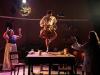
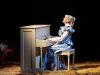
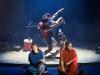
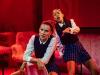
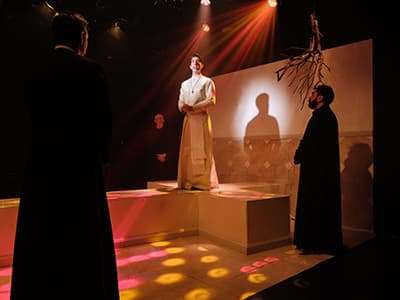
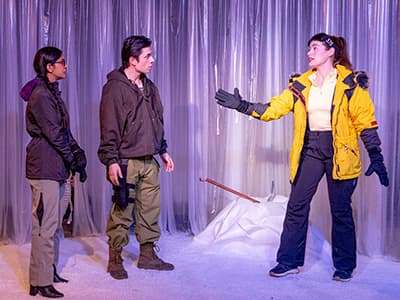
However, this did not deter the production team headed by the brilliant Netia Jones. Purcell's music easily trumps any dramatic shortcomings. Dispensing entirely with any attempt at plot, she presented the work as a series of tableaux, united only by the underlying theme of the work: the pleasures, vicissitudes and pains of love. (Purcell shares with Mozart the distinction of having penned some of the most bawdy songs in the history of music).
In the first half of the show these tableaux presented: an airport departure terminal, a forest infested with bird-watchers, a late-night bar, a bus-stop, a newsroom, and a morning-after bedroom scene in which no-one seems sure which partner is theirs. All these were ingeniously interwoven with Purcell's songs, which include many that are well-known from recitals even today.
All these were sung superbly by the cast, which as we have come to expect from Pinchgut contained not a weak link. If Karen Breen and Cathy Di Zhang always steal the show with their integration of spontaneous acting ability with vocal beauty and flexibility, those singers with lesser thespian skills unfailingly rivetted attention in their solos. Familiar voices such as Anna Fraser, Olivia Payne, Louis Hurley and Andrew O'Connor are joined by several relative newcomers to Pinchgut, all providing jewels in Purcell's magical tapestry.
Their excellence was all the more remarkable in the light of the extremely low pitch of the performance. In keeping with musical director Erin Helyard's unwavering commitment to historical performance practice, the show was played and sung at A=392. This is close to a whole tone lower than present day concert pitch, and close to a semitone below what we loosely call baroque pitch, the pitch at which most of the instruments in Pinchgut's orchestra, the Orchestra of the Antipodes, normally play. Hard though this is for string players and singers, it is practically impossible for the oboes and trumpets. Both pairs of these instruments adapted remarkably well to the pitch below that which their instruments were built for, but sometimes at the expense of nuances of expression. This was particularly noticeable in the beautiful plaint, "O let me weep" where Adam Masters, playing a split-new Spanish oboe, could not quite match the extraordinary expressivity of Keara Donohoe's mezzo- soprano.
Since I hope that you, my readers, will take the opportunity to see this production (if you haven’t already), I am not going to drop any spoilers about the amazing scene Netia Jones devised for the tableau of the four seasons which opens the second half. This is followed by a wedding scene where three couples are married – a gay couple, a hetero couple, and a lesbian one. The advice that Juno, goddess of marriage, gives to the couples is so much better than that which our conventional marriage celebrants give that I feel constrained to repeat it here. She says:
Thrice happy lovers, may you be
For ever, ever free
From that tormenting devil, Jealousie,
From all that anxious Care and Strife
That attends a married life.
So there is a moment of seriousness here. This seriousness is immediately amplified by the plaint, a cry for lost love which follows the cheerful wedding. This is sung over one of Purcell's favourite devices, a ground bass; which is of course the device he used in a more famous plaint, Dido's Lament.
Thrice happy lovers. Jones picked up on this threesome, filling the stage space by tripling the action in some scenes. This very effective technique was for me reminiscent of Peter Greenaway's use of tripling in Louis Andriessen's opera "Writing to Vermeer" staged at the Adelaide Festival 25 years ago. So, there are 3 check-in desks in the airport terminal; and three groups of birdwatchers in the forest, as well as three married couples.
17th century music is replete with word painting, and the songs in The Fairy Queen have more than their fair share. "Make the plea-ea-ea-e-e-ea-ea-sure longer last", sings Secrecie. But Purcell is only equalled by Monteverdi in the use of silence; moments in the music when almost nothing happens. Monteverdi does this towards the end of L’incoronazione di Poppea at the start of Ottavia's lament, because she cannot bring herself to say the word "addio" to the Rome from which Nero has banished her. Helyard conjured absolute silences during the Night's song, sung with immense tenderness by the bass Andrew O'Connor. Each time the silence came, Helyard made it longer, and you could have heard a pin drop.
Unsurprisingly (because this is Pinchgut), the musical side of this performance was impeccable. More surprisingly (because this is Purcell), it was also a gorgeous night at the theatre.
Event details
Pinchgut Opera presents
The Fairy Queen
by Henry Purcell
Director Netia Jones
Venue: Roslyn Packer Theatre, Walsh Bay NSW
Dates: 7 – 14 June 2025
Bookings: www.pinchgutopera.com.au