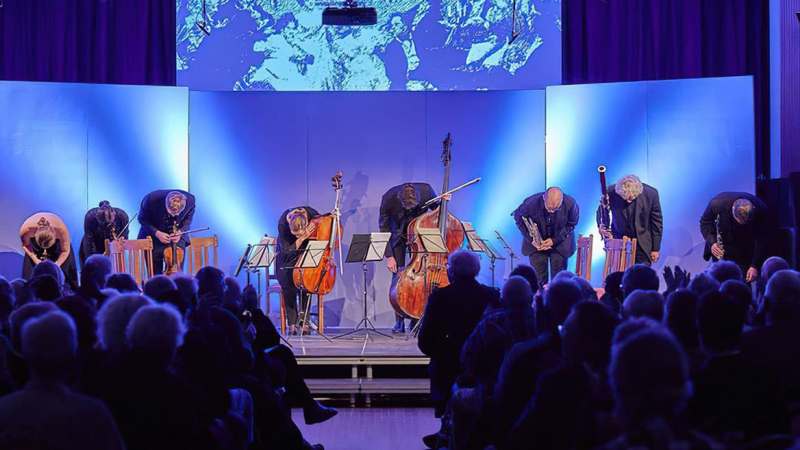
The Blackheath Chamber Music Festival is now in its 3rd iteration. It was started by Catherine Harker, who is still the artistic director, in 2021, partly in response to the privations, for audiences and musicians alike, occasioned by the Covid lockdowns. Performers couldn't earn, and audiences were starved of live music, for which no amount of online delivery can ever substitute. This year’s Festival consisted of nine concerts, held over three days, which I found an improvement on last year’s, when the Festival lasted for four days with 12 concerts. As in 2022, the concerts were performed by some of the finest musicians of this country.
Before one of the concerts in this year's Festival, Chris Tobin, a local Dharug man, told a story about music in his culture. There was once a young woman with a beautiful voice, and everyone in the camp loved to listen to her singing. But there came a time when mutterings started in the camp. "We do all the work while she does nothing but sing!” A spirit emerged from behind a cloud who said "I love her singing too. Let her sing! There are plenty of people to do the work.“ So they did, happy to support her singing all her life. When she died, the spirit appeared again and buried her body by a stream, whose music continued to embody the singing of this woman and delight all who heard it.
There are many powerful resonances in this story, among which is the decision to support a member of society whose sole duty is to create beauty. There have been some countries in Western cultures which have supported composers and performer on an ongoing basis – the Netherlands in the 80s and 90s, for example – but the closest that white Australia has ever got to this was the fellowships established by Paul Keating late last century. Otherwise, performers survive from concert to concert, and composers from commission to commission. None are supported simply to be musicians, like the singing woman in the story. We can learn so much from the transformative stories of our First Nations people.
Blackheath is gorgeous in autumn, with the trees making the streets incandescent with every colour from green through yellow, orange, red to crimson. It is no accident that the festival is held at this season. But the abiding image for me from the wonderful series of nine concerts constituting this festival is from another First Nations story, “How the Opal came to be”. This was told by the late Auntie June Barker from the Comeleroi people, whose land includes Lightning Ridge. It speaks of the splendid colours of a butterfly's wing, which were washed off its wings by rain, and turned into a rainbow, which then sank into the ground as iridescent opal stones. Alice Chance’s piece, Precious Colours, performed by The Marais Project in the fifth concert, was inspired by this story.
The festival began with a recital by Riley Lee, the first non-Japanese player ever to become a Grandmaster of the shakuhachi, and Satsuki Odamura, perhaps Australia’s foremost exponent of the koto. Riley was the first shakuhachi player I ever heard, some 45 years ago, and his skill in drawing out the subtlest of gradations of sound from his flute never cease to bewitch me. He played two solos, including a Honkyoku, The Lion of Azuma. Honkyoku are the classical repertoire of the shakuhachi, and were traditionally played by Zen monks from the Edo period and before, and they have that quality of eternal presence that is a hallmark of Zen. Riley’s other solo was four of Hildegard von Bingen’s antiphons, which he played in a style almost as if they too were Honkyoku, and they indeed sounded like “feathers on the breath of God”, which is how Hildegard referred to her music.
Satsuki Odamura’s koto playing was a revelation to me. She made the instrument sound sometimes like a harp, sometimes a harpsichord, sometimes a lute, and sometimes a cimbalon, but all these sonorities were coloured and enhanced by the use of many shades of vibrato. The solo pieces Gaku (isn’t it wonderful how the same word means both music and pleasure in Japanese) and Snow demonstrated the huge dynamic range and subtlety of detail that the koto is capable of, and which I had never imagined was possible. She played the shamisen in one number, and I have to say that that three-stringed guitarlike geisha instrument played with a huge plectrum paled in comparison to the koto. Even Satsuki’s magic couldn’t do much with it. She and Riley Lee also played together in two pieces written in the 1970s for shakuhachi and koto, in which they revelled in the extreme contrast between the sonorities of these two instruments.
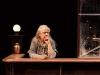
From the third concert to the last in the Festival, the audience was treated to one extraordinary delight after another. The second concert though, I have to say, didn’t quite work for me. The program was called “With love, Amadeus”, in which the great Shakespearean actor John Bell read from Mozart’s letters (mainly to his father). These were interspersed with fragments of Mozart’s piano compositions, from Köchel no. 1 written when he was five, to the wonderful Rondo in A minor, composed in the last year of his short life. These were played by the versatile pianist Simon Tedeschi, always expressively, but not always in a style appropriate for Mozart.
So far so good. But I did not like hearing the bleeding chunks of music, even played by Tedeschi. These fragments, “superbly abridged”, brought home to me how large a part of Mozart’s magic lies in his formal construction. It also reminded me of the exchange between the Archduke and Mozart in the play, Amadeus, by Peter Shaffer which has been on in Sydney recently, and which several of the audience saw. “Too many notes, my dear Mozart, too many notes” says the archduke. “And which ones would you leave out?” replies Mozart. How very rich that play is in comparison to John Bell’s and Tedeschi’s endeavour to bring Mozart alive.
But the most unfortunate thing about this concert was the use of the sound equipment. John Bell’s microphone kept switching on and off so that his reading of Mozart’s letters sounded like those incredibly unsatisfactory conversations we have on WhatsApp when one party is almost out of range. Why did he have a microphone at all, I wondered – he’s an actor after all. And Tedeschi’s microphone was kept on during his piano playing, with the resultant distortion of random notes spoiling his very sensitive renditions of the fragments. Fortunately all later occurrences of microphone failure in the Festival only occurred during the introductions that performers gave to the music.
The rest of the Festival was an unmitigated pleasure. The first evening concert showcased the Orava quartet, one of Australia’s very finest string quartets, whose programs are distinguished by including pieces from the outer reaches of the repertoire. In this concert, having started with the first Contrapunctus from the Art of Fugue, they played a quartet by Manuel Canales, a Spanish composer from the mid-18th century who I had never even heard of. It was played with the exuberance I have come to expect of this ensemble, which brought out Canales’ connection with Spanish dance music and with the harpsichord sonatas of Domenico Scarlatti. After Mozart’s very first string quartet, composed when he was 14, the Orava were joined by that paragon of Australian guitarists, Slava Grigoryan, for a Boccherini quintet. Entitled Fandango, this work also featured a cello part that was so extraordinary that the audience was looking round the room to see where the harmonics were coming from. It gave Karol Kowalic an opportunity to show what an absolutely brilliant cellist he is.
The second day began with a program I have waited fifty years to hear. Pianist Benjamin Kopp was joined by a stellar quartet of wind instruments to play the quintets by Beethoven and Mozart for piano and winds. The Beethoven piece is one of three that he modelled closely on works by his idol Mozart (the others being his String Trio op 9, and his String Quartet op 18 no 4). In all cases the keys and the movement sequences are the same as the Mozart models.
The ensemble played the works in the reverse order of composition. When I asked the bassoonist, Matthew Wilkie, why they did this, he said, oh, it just came that way; but I believe it was because they considered the Mozart a better work. I completely agree with them; it is a better work, in just about every way. Mozart was so proud of this quintet that he wrote in a letter to his father that he thought it was his best piece. Beethoven’s quintet is also beautiful, particularly the slow movement, in which each of the wind instruments gets a longer solo than happens in Mozart’s work. But while Mozart knew exactly how to write for wind instruments, Beethoven’s ear was not so refined even before his deafness, and as a result his quintet is much harder to play in tune. Not that you would have realised that hearing this ensemble play, consisting as it did of principal wind instrument players from the best orchestras in Australia.
The acoustic of Phillips Hall, which is surprisingly good for a country memorial hall, tended to favour the wind instruments. Kopp’s piano, even with the lid fully up, could not quite match the dynamic of the wind players, and that was a shame, particularly in the Beethoven where the piano (Beethoven’s instrument par excellence) is frequently pitted against the whole wind ensemble. But the acoustic was perfect for the next program in this Festival, given by The Marais Project.
The core of this group is Jennifer Eriksson on viola da gamba, and lutenist Tommie Andersson, who played theorbo in this concert. They were joined by Susie Bishop, both singing and playing the violin (sometimes both in the same piece) and the countertenor Russell Harcourt. Apart from a rather slight gamba piece by Marin Marais (I wanted to hear some of the more substantial pieces by this interesting Baroque French composer), and a toccata for lute by Piccinini, the program included one or both singers in every piece.
Susie Bishop’s voice is just gorgeous. Light enough for exquisite coloratura, strong enough for the lyricism of Handel, she has everything that a singer of baroque music needs. I loved particularly her German arias by Handel; she seemed to revel in the lyricism of this master tunesmith. And when she sang duets with Russell Harcourt, the blend was amazing, and the balance perfect, apart perhaps from Purcell’s “Sound the trumpet”, which is notoriously low for the second voice.
This concert included the two most harmonically vapid pieces of the Festival – Michael Nyman’s “If”, and Carl Vine’s (of all people!) “Love me sweet” – but also one of the most harmonically delicious – Monteverdi’s “Si dolce è il tormento.” Susie Bishop’s rendering of this was outrageously erotic, as was the encore, the final duet from Monteverdis’s “L’incoronazione di Poppea” – meltingly lovely music sung by two of the most evil characters in all opera, the emperor Nero and the prostitute who became his empress.
For the evening concert on the second day Slava Grigoryan was joined by his wife, the cellist Sharon Grigoryan, and later on by his brother, fellow guitarist Leonard. Their program was exceptionally well-judged, including works by Ravel and Granados, and a particularly moving performance of Slava’s arrangement of the Marcello Oboe concerto. The highlight of their program, though, was undoubtedly Nigel Westlake’s “Songs of the Forest”, about the Tasmanian wilderness and the need for its preservation (still an issue after all these years). Westlake’s harmonic palette is always interesting, and his textures flow by entrancingly – but it takes players of the stature of these three to make it work.
Unfortunately I had to miss the Sunday morning concert, given by the brother’s Grigoryan, Slava and Leonard. This was a pity as it included pieces by my favourite guitar composer, Leo Brouwer. However, it meant that my ears were fresh for the final two concerts of the Festival, which were outstanding.
It’s interesting that Ravel said of his Piano Trio in A minor the same thing that Mozart said of his quintet for piano and winds – that he thought it was his best work. Among many fine piano trio ensembles currently playing in this country I think the Streeton are pre-eminent. Last year I wrote that their performance of Brahms’ trio in B major was the best I had ever heard, and here I am in danger of repeating myself about their playing of the Ravel trio. Emma Jardine, the violinist, leads with immediacy, strength and daring, and cellist Rachel Siu is an utterly reliable partner. The pianist, Bernadette Harvey, was simply astounding. She launched herself into Ravel’s phenomenal difficulties with an infectious sense of fun and play that responded to Emma Jardine’s lead, in spades, and drew the audience into the sphere of electric energy that the Streeton trio’s whole performance exuded.
This concert had begun with the wonderful Diana Doherty playing the Mozart oboe quartet. She has played this work a million times, and is nonetheless capable of finding something different in it each time. The string players didn’t seem to have had quite enough rehearsal time to be able to follow all of the richness of detail that Diana Doherty elicited from this piece, but it was a joy to listen to anyway.
And then another Nigel Westlake piece. Gosh he is a good composer. This was his “Spirit of the Wild” for oboe and orchestra, here played by Doherty in an arrangement for chamber ensemble. She said she felt like an eagle circling above the wildness – I thought of Tasmania again – and swooping down on the mice below. Incredibly hard for the oboe, it takes an eagle like Doherty, for whom it was written, to bring it off. It’s a busy, engaging piece, with few moments of lyrical repose, and the last section consists of a series of cadential gestures, each of which could perfectly well close the work. These sounded just like Doherty’s description of an eagle circling and pouncing. I reflected how something missing from the work of many Australian composers is knowing how to finish – they could all have borrowed any number of closing gestures from Westlake’s finale.
The final concert, attended, graciously, by the State Governor of NSW, Margaret Beazley, was in three parts. It began with the first performance of Justin Williams’ Three pieces for String Quartet and Voice. This work is a setting of various passages from the Old and New Testaments, plus excerpts from the declarations of Vatican II, a prayer attributed to Francis of Assisi and some words by Williams himself. While the string parts had a certain flexibility and sinuosity, I found the vocal line, sung impressively by Christopher Richardson, rather unyielding and at times even ponderous in its desire to put the religious message across without ambiguity. Such lack of ambiguity militates against poetry, and when religious messages imbue works of art to the extent shown in this work, the space for poetry tends to be shut down. So I was unable to enjoy this piece as much as I might have done without the text.
Christopher Richardson then sang the five Shakespeare songs, Let us Garlands Bring, by Gerald Finzi, with Simon Tedeschi’s always sensitive accompaniment. Richardson is thoroughly at home in English art-song, and there was an unchallenged rightness about his performance that was redolent of the values of the British Empire of the period in which these songs were written (and the period which gave us state governors). He concluded with an expressive and heartfelt rendering of Calvin Bowman’s beautiful song, The Night.
The festival concluded, in case we hadn’t had enough of the pinnacles of Western chamber music in the course of the weekend, with one of its highest peaks, Schubert’s Octet. Every member of the ensemble played as if they had wanted to play this wonderful music all their lives. Alexandra Osborne led the ensemble with care and passion, and to hear her, and clarinettist Francesco Celata, and Euan Harvey on horn, playing the different combinations of the theme of the first slow movement was to experience the “heavenly” in Robert Schumann’s remark about Schubert’s “heavenly lengths”. The Octet’s six movements last almost an hour, but nothing flagged as the musicians teased out all the implications of the slow introduction to the first movement – love, dancing, yearning, and even terror – through to the unchecked exuberance of the finale.
Catherine Harker has created something really special in this Festival. And for the first time she had the help of a large and able crew of administrative staff. She chose one of the best MCs imaginable in Stephen Adams, whose introductions to the concerts were brief, to the point, respectful, and completely musically literate. Always honouring the performance traditions of First Australians, and making the point clearly that we perform on their land, his warmth and zeal set the tone for the whole festival. Alice Coffey and Louise Johnson were models of charm and efficiency in front of house, and Coffey’s work as media manager has clearly lifted the brand of the Festival. The whole crew served wine in the interval of the last concert with a panache that gave the audience of well over two hundred a glass of wine each in less than a quarter of an hour. This all contributes to a setting in which a festival audience can completely relax.
I did wonder about the title of the Festival though. Baroque and Beyond. What did the beyond mean? Beyond in which direction? And although there were a couple of performances of Bach on modern instruments, there was only one concert in which baroque music was played in a historically informed way – that given by the Marais Project. But this is a quibble, a quibble worthy of a pedant like me, and certainly did not detract from a superbly enjoyable feast of wonderful chamber music brilliantly performed. May there be many more!
Event details
Mountain Productions Inc presents
Blackheath Chamber Music Festival 2023
Baroque and Beyond
Festival Director Catherine Harker
Venue: Phillips Hall, Blackheath NSW
Dates: 21 – 23 April 2023
Bookings: www.mountainproductions.com.au