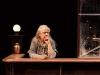
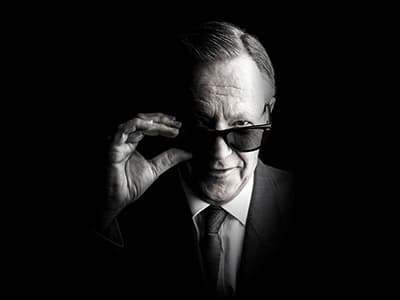
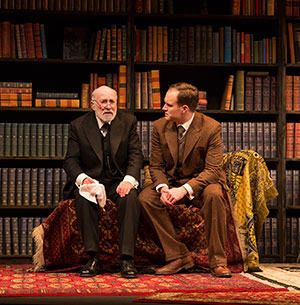
 Left – Henri Szeps and Douglas Hansell. Cover – Douglas Hansell and Henri Szeps. Photos – Mel Koutchavlis
On the eve of Chamberlain declaring war on Hitler, C.S. Lewis arrives in the London office of Sigmund Freud amidst air-raid sirens to debate the existence of God and the nature of faith.
Did this actually happen? Well, no… or at least probably not, but that’s quite a “hook” for play!
Mark St Germain was inspired by Armand M. Nicholi Jr.’s book The Question of God, which compares Lewis and Freud's writings on religion, to pen a wonderfully compelling play in which they literally meet. Whether one should classify the result as a work of speculative theatre is perhaps a reductive question, as it is not only a great discussion of big ideas, but also an highly charged meeting of the minds between two keenly observed characters, as extrapolated from their real biographies. Indeed, although there is a loose plausibility that these two could in fact have really met, it is the way Germain’s script homes in on and dramatically articulates Nicholi Jr.’s subject matter which makes this imagined debate between historically significant writers all the more intriguing to watch.
Although Freud was a declared atheist and Lewis’ faith would be obvious to adults looking at the messianic overtones of Aslan the lion let alone his explicit works as a Christian Apologist, nevertheless making the play’s central debate one about God, Jesus and the ir/rationality of belief therein, as opposed to discussions of the merits of psychoanalytic theory or children’s fantasy books may not seem an obvious choice. Indeed, these respective topics for which the two men are ultimately far more famous are indeed brought up (although by 1939 Lewis had yet to write The Lion, the Witch and the Wardrobe), as are elements of their biographies such as Freud’s flight from the Nazis and Lewis’ chaste relationship elsewhere dramatised in Shadowlands, these matters all ultimately come back to the question of God. Or rather, Freud’s incomprehension of Lewis’ capacity as an intellectual to believe in God.
The narrative setup is that Lewis has arrived at Freud’s invitation, largely triggered by the former’s satirical portrayal of the latter in his book The Pilgrim’s Regress which, combined with a mutual appreciation of Milton’s Paradise Lost, led this fictionalised Freud to question how a man of such keen insight could be subject to the “delusion” of religion, and as something of a born-again, at that. Indeed, Lewis discusses at length how he was himself a former atheist who experienced a moment of revelatory faith that prompted him to embrace the divinity of Jesus, on a complex and constantly re-assessing basis whereby faith and intellect mesh in a fashion which the clinically rational Freud finds repellent.
The play is not solely concerned with Lewis’ faith though, but also Freud’s absence of same, with free-wheeling tangents also exploring issues of self-determinism, the value of shame and the question of whether morality is intrinsic, experiences of the last World War and contemplations on the imminent new one, and the ethics of suicide, as Freud was at this time dying of painful mouth cancer. Indeed, the problem of Freud’s lacerating oral prosthesis interjects itself into the “action” of this essentially very talky play, by excruciatingly causing him to bleed as he becomes conversationally agitated at various points, engendering Lewis’ sympathy. Despite their seemingly irreconcilable differences in personal philosophy, these two robust intellectuals from very different worlds bear each other no antipathy. They even develop a kind of gentlemanly affection of sorts as they vociferously debate the issues yet bond over blood and the threat of the oncoming Blitz.
Much to Lewis’ bemusement Freud cannot help himself in attempting to constantly psychoanalyse the younger man, to explain away his faith as neurosis, attempt to expose contradictions between his stated beliefs and actual behavior, or interrogate his private life as the outgrowth of his childhood, as well you might expect. Yet Freud does not escape psychological probing in turn, as Lewis questions the selfishness of his intended suicide, the nature of his relationship with a female protégée, and elicits some interesting reflection on the old man’s lifelong distrust of the emotionally manipulative properties of music.
Although a little dwarfed in the cavernous setting of the Theatre Royal, this straightforward conversational play is simply but effectively staged on a large and lavishly adorned set, recreating Freud’s office in the best tradition of proscenium arch verisimilitude. However it is of course the performances that are chiefly on display here, and it is a very strong pairing under Adam Cook’s direction. Douglas Hansell is intriguing as the younger Lewis, not yet the famous creator of Narnia, portraying a man both on the defensive yet politely assured of his own convictions. Hansell manages to convey this characteristic without arrogance but rather nuanced self-doubt. Henri Szeps, deserving of his status as something of a quiet legend of the stage, is superb as Freud. Despite his German accent having a tendency to slip almost as often as his troublesome earpiece was doing on the night, Szeps eschews caricature and deftly plays the character’s many shades from intractable and harrying to sympathetic and surprisingly tender. Together they form a well-matched double act which is never anything less than captivating.
As stated, this is a primarily verbal piece of theatre, a realtime two-hander comprising a long exchange of dialogue and little else in the way of stage action. That, combined with its lofty topics will certainly mean this play is not for those seeking only high drama or spectacle, and some passing foreknowledge of the historical Freud and Lewis is recommended in order to best appreciate these lightly fictionalised representations. But for those to whom this sounds like an intriguing premise, it is an excellent production of a totally engrossing play.
FREUD’S LAST SESSION
by Mark St Germain
Directed by Adam Cook
Venue: Theatre Royal | King Street, Sydney
Dates: August 15 – September 8
Times: Tues 7.30pm, Wed – Sat evening 8pm, matinees Wed 1pm, Sat 2pm, Sun 3pm
Tickets: from $59.90 (transaction fees apply)
Bookings: ticketmaster.com.au | 1300 723 038