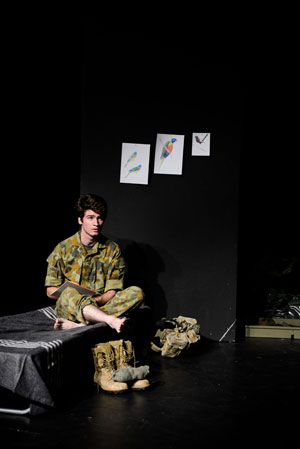
 The First World War marked the turning point in how war is perceived. With the unprecedented loss of lives reported daily on the front pages of the British press, old notions of honour fighting for one’s country were challenged. War poets Siegfried Sassoon and Wilfred Owen wrote of the horrors in the trenches and afterwards, T.S. Eliot wrote of the moral bankruptcy that comes from the experience of war. Set in 1916 in the trenches of the Western Front, Nathan Finger’s play takes up these ideas from WW1 and applies them to war more broadly.
In the opening scene, Officers Parsons (Lachlan McNab), Cohen (Carl Quizzau) and Clarke (Manny Kanellis) are back from a hard day on the job dealing, again, with the monstrous grind of war. Parsons is suffering from Trench Foot and hopes that if it turns gangrenous, he might be sent home. Despite the terrible food, obscene loss of life and callous commanding officers, the other two are less defeated by their experiences and are trying to make the best of things.
When Sydney Abba arrives on stage as the very British Col. McGrath to blithely send yet another Australian officer to his death, she lifts the energy level and introduces a new tone to the play that almost steals the show. What, up until the Colonel’s entrance, had been a realist piece, becomes more textured. Abba is a wonderful performer and she makes the most of her blackly comic, inept and callous character.
Writer/director Finger has a lovely sense of humour and a flair for comic characterisation. It is most obvious in this character but elsewhere too, in the rhythms of his comic banter. At times the play has an absurdist tone, reminiscent of Fernando Arrabal’s 1961 play Picnic on a Battlefield.At other times it shifts closer to realism and seriously tries to establish the value of war.
In the first act Lt. Parsons is physically and emotionally depleted and, in trying to express his character’s depression, McNab sometime loses the energy required of him as a performer. In the second act, Parsons exchanges depression for inebriation and, fuelled by cynicism and anger, McNab really comes into his own and delivers a strong performance with much more punch. Parsons embodies T.S. Eliot’s idea of someone who has lost their moral rudder as a result of his war time experience. One of his jobs is to write to the Parents of fallen soldiers, but there are so many of them that he can’t keep up. He sleeps under huge mounds of letters. Worse still, he no longer cares that it is important to do it as an act of kindness to the families.
Col. McGrath introduces a newly arrived officer, Capt. Collins, played by Sammuel Dobbie-Smitham. Collins is a tough, career soldier who has spent the last 11 years training troops in Egypt. He truly believes in the nobility of the cause, but even his entrenched ideology is shaken by the reality of trench warfare. The central ideas in the play are expressed through the exchanges between these two characters. Representing disillusionment and patriotism respectively, Parsons and Collins argue the merits of their positions regarding the nobility of war and it might have been interesting to see this discourse developed further.
Though Finger has set his play in 1916, the scenario could be any war and his soldiers are “Everyman” characters. Little anachronisms are slipped in as clues to Finger's intentions, referencing a George Gershwin song from the late 1930s, Hitler, the Domino Theory, and Apocalypse Now. He becomes more explicit about this idea later in the play. Finger suggests that in every war the same notions of moral righteousness and duty to country are expounded, but that every war is the same in its dehumanising effect upon its participants, resulting in moral bankruptcy.
Nathan Finger has written and directed this student production at Macquarie University. The Lighthouse Theatre looks much older than most of the buildings on campus. Although small and run down, the foyer bristles with the sense of welcome and expectation that the STC has been trying to achieve in its new-look Wharf foyer. Similarly, the performance studio is a very workable space. There is no set designer credited, nor was one required. On stage there are a couple of camp beds, a table and a couple of crates to sit on. Just what was needed.
Finger’s play is brand new and without any input of a dramaturg or the developmental help of a workshop (apparently Andrew Bovell brewed the masterpiece that is The Secret River over 10 years). While this play needs some further development in shaping the dramatic structure and adding depth to the central idea, at this early stage it shows potential and the potential of Nathan Finger as an emerging writer.
Narrow as the Line
by Nathan Finger
Director Nathan Finger
Venue: Lighthouse Theatre | Macquarie University, Gymnasium Road, North Ryde, NSW
Dates: 18 - 23 March 7:30PM
Tickets: $10 – 15
Bookings:
Sydney Reviews
Narrow as the Line
- Details
- Rebecca Whitton
Most read Sydney reviews
The Lark | Hey Dowling
Noni Hazlehurst brings Rose and The Lark to colourful and compelling life in this one-woman show.
Pride & Prejudice* (*sort of) | Neil Gooding Productions & Woodward Productions
This rollicking musical take on Jane Austen’s beloved novel is a side-splitting crowd pleaser.
Heartbreak Hotel | EBKM
Heartbreak Hotel invites its audience into an intimate portrait of the universal and isolating experience of heartbreak.
Current | Sydney Dance Company
While Bonachela’s work is, as always, dreamily lovely, for me the highlights were absolutely the three commissioned choreographers: Azzam Mohamed, Jenni Large and Raghav Handa.
The Gospel According to Paul – The Second Coming | Soft Tread Productions
The Gospel According to Paul is meticulously crafted entertainment. It’s uplifting without pulling any punches.
The Gospel According to Paul is meticulously crafted entertainment. It’s uplifting without pulling any punches.

While Bonachela’s work is, as always, dreamily lovely, for me the highlights were absolutely the three commissioned choreographers: Azzam Mohamed, Jenni Large and Raghav Handa.