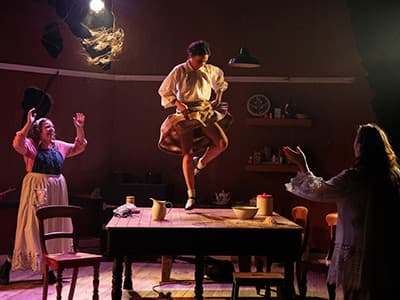
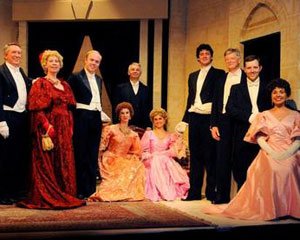
 I must say, I find it puzzling. Charley's Aunt, a three-act farce by Brandon Thomas (an actor, first and foremost), written in 1892, smashed every box-office record known to British theatre. At The Globe, alone, it ran for four years and not many fewer than 1,500 performances. Puzzling because, while it's a very good play (particularly as it wears on), it's by no means a great one: the writing doesn't have the precise construction or acerbity of, say The Importance Of Being Earnest. Mind you, it's arguable that Thomas' play, which came only a few years before Wilde's, served as something of a template and inspiration. It also bears a naked and unmistakable similarity, or vice-versa, to Billy Wilder's Some Like It Hot. I'm not sure any credit was given by Wilder, but it probably ought've been.
Having staked my reservation (I realise questioning such a play may be deemed akin to dismissing the The Holy Bible as bunkum), I can barely think of a more suitable staging-post than the old-school Genesian Theatre, which continues to make it's name with, among other things, costumes, classics and crowd-pleasers. It's a theatre that seems to have carved out a very specific niche, knows its market and goes after it. That market tends to have an elderly skew, so it's in no way surprising GT should plump for a comedy of errors.
In the beginning, we're introduced to Jack, an Oxford undergraduate, moping about in his rooms. He's smitten. By Kitty. He means to put the hard word on her and is deliberating as to the how and when. His long-suffering 'man' is trying to get his attention, but Jack is too preoccupied and thoroughly put out by the valet's interjections. It's all terribly British, terribly proper and terribly late Victorian. Owen Gimblett's set design reflects this, as do Peter Henson's costumes. (Set construction may be a wee bit third-world wobbly, but it otherwise looks the part. And one can view its touch-and-go nature as slapstick. Henson has quite a reunion to live up to: Cecil Beaton costumed a 1949 West End revival.) In due course, Jack's babbling, nervy friend, Charley happens along and the two moon about, pathetically confiding their respective affections; not for each other, but for Kitty Verdun and Amy Spettigue, respectively. They are looking for the right setting to confess their feelings to the young ladies and decide (well, Jack does; the dithering, fussing Charley reluctantly agrees, since Charley seems reluctant as regards just about everything) the imminent arrival of Charley's aunt, from Brazil ('where the nuts come from' and, later, also from the cotton-mouth of her extemporising imposter, 'I'm Charley's nut, from Brazil, where the aunts come from'), presents a window of opportunity. They hit upon the idea of hosting a luncheon party, at which Donna Lucia can act as the girls' chaperone. Of course, Charley's never actually met his aunt previously and they've precious little means to be throwing any such thing, but they seem momentarily gratified by their own cleverness. It's all terribly spiffing, what?
Unfortunately, there are no contingencies built into their not-quite-foolproof plan and, as luck would have it, Donna Lucia is inexplicably detained. This sends their plans into a tailspin, but, just when trivial life as they know it is about to end, they are struck (well, Jack is) by another fit of genius: why not enlist the assistance of their mutual friend, Lord Fancourt Babberley? This is where the farce proper begins, as Babberly dons wont's clothes to become the Donna.
Shane Bates ably directs. A slow and somewhat shaky start ramps up steeply after interval, at which point the comedy builds to a crescendo. Carlin Hurdis tries to make the most of every one of Jack's (and the playwright's) lines, but the lines aren't always there for him. At times (early on), he doesn't seem quite settled or sure of himself and, as a result, neither were we sure of him, or his character. But on the whole, he makes a jolly good show of it. Thomas Greader is Charley Wykeham and with his studiously furrowed brow and worrywart disposition rounds out his role fulsomely. Justine Kacir is agreeably ladylike as Kitty, going through all the prescribed notions and motions of arcane etiquette, while a the same time subtly betraying an intelligence that indicates recognition of the pretence and folly in it all: one gets the impression Kitty sees it as a necessary evil. Kate Parker-Frost's Amy fits a similar mould, pretty much to a tee. Lilianna Komljenovic is charmingly sound, too, as Ela Delahay, the grown-up orphan in the guardianship of Charley's aunt. As with Hurdis' Jack, it seems to take Stephen Holland about half the play to get up to full operating temperature as Brassett, the hard-done-by but knowing butler. Once there, he's good, but his performance could and should be 'bigger', overall. LynnTurnbull Rose has presence and is just the ticket as Donna Lucia D'Alvadorez. Both David Stewart-Hunter, as Colonel Sir Francis Chesney, and Timothy Bennett, as Stephen Spettigue, present as mature actors in the best sense of the word and, site captivatingly, in different ways: Stewart-Hunter, by way of calm, cool understatement; Bennett, as a larger-than-life caricature. Their vying for the affections of the 'woman' they take to be Charley's wealthy, widowed aunt is, of course, at the heart of the buffoonery. But the acknowledged standout has to be Nicholas Pond as the cross-dressed Lord Fancourt Babberley. (He's in good company, the likes of Leslie Philips, John Mills, Frankie Howerd, Tom Courtenay, Griff Rhys Jones, John Gielgud, Rex Harrison, Jose Ferrer, Roddy MacDowall and Raul Julia have gone before him.) And it's Babberley's transition from reluctant recruit to proud, middle-aged ma'am that's the truly piquant comedic twist; in its funny way, raising all sorts of questions, I suppose, about what constitutes masculinity, versus femininity and whether or not appearances can, sooner or later, deceive, condition and socialise the would-be deceiver, as much as deceivee.
To my mind, the continuing popularity of this play, a staple, is as much about nostalgia and homage to theatre history as anything intrinsic. And that's ok. The production could be better, but, by the time we get to the last act, practically any misgivings are all but forgotten. Bates (and associate director, Tom Massey) have ensured a good night out, if not a great one, for many, almost regardless of the true worth of the play itself.
Genesian Theatre presents
Charley's Aunt
by Brandon Thomas
Directed by Shane Bates
Venue: Genesian Theatre | 420 Kent St, Sydney NSW
Dates: 12 Jan - 23 Feb 2013
Tickets: $27 – $22
Bookings: www.genesiantheatre.com.au | 1300 237 217