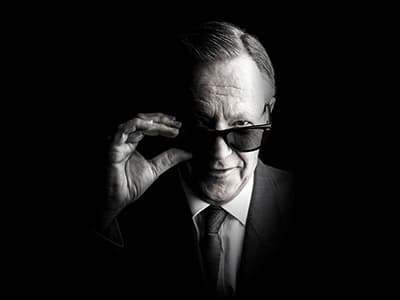
Even by the standards of excessive precocity, Rachmaninoff was a smartarse, having written his Cinq Morceaux de Fantaisie (Opus 3) at nineteen. At that age, completion of a suite of five 'fantasy' pieces would be impressive enough, but their quality was such that the elder composer and countryman, Tchaikovsky, took a shine to them. And what's not to like? Especially in the hands of Geoffrey Saba, at a Stuart piano. I doubt there's a Toowoomba boy who's done quite as well as GS. Of course, Queensland and Australia ostensibly lost him, to London, may years ago. So it was good to have him back at the acoustically admirable Independent Theatre, in North Sydney; an intimate theatre which seems to mirror the refinements of Saba's playing.
The Rach fantasy suite, if I may call it that, begins with Elegie, in E Flat Minor (Opus 3/1). You don't have to be Russian to be deeply affected and moved by the sadness with which this piece is so potently imbued. It is haunting from the first; paradoxically, disquieting, yet becalming. Thanks to the technology of the piano roll, it's possible to listen to the composer's performance of same and, heretical as it may be to say so, I much prefer Saba's. If it's possible for a pianist to colour the author's work with even more feeling, then I'll warrant Saba achieves it. He ensures there's no doubt about the fact Elegie is, intrinsically, of immersive, tragic beauty.
To my ear, regardless of his Lebanese roots, he plays with a Russian fervour. There's no pussyfooting; his rendition is mercifully devoid of faux, fey, or fay delicacy. It is unaffected; ringing with sincerity, clarity, forthrightness, candour, class and maturity. Nothing sounds quite like Rachmaninoff and none sounds quite like Geoffrey Saba. He executes the elegy not so much as a dirge, as moderato lament. It exudes the utmost taste.
Neither are there any prolonged pauses between the five pieces. Saba launches without ado into the Sérénade, in B Flat Minor (Opus 3/5), a piece suffused with lightness, brightness, innocence, openness, surprise and a bouncing jollity; as lively and dynamic as ever in the care and caress of Saba at the world's best piano.
Tchaikovsky held the Mélodie in E Major (Opus 3/3) in especially high regard. If only he could hear Saba's rendering. The piece itself seems to carry a nostalgic sadness; a yearning for times past, now lost. Yet it's never quite that simple with Rachmaninoff. There are dissonant cadences to counterpoint that very feeling and, if you listen very carefully, you might just pick up the inspiration for a tune from My Fair Lady. Saba engenders warmth and sensitivity, even through the complexities hidden in what is otherwise a straightforward melody, as its name suggests.
Prélude in C Sharp Minor (Opus 3/2) only but confirms my faith in Saba. Based on my listening experience, only the rarefied likes of Vladimir Horowitz rival his interpretation. (Not even Harpo Marx' exploding piano, in A day At The Races, touches Saba.) Arguably the best sixty-two measures ever committed to manuscript, the prelude invigorates with a dark, but not destructive, energy. It's no surprise it should've emerged as one of Rachmaninoff's most recognisable pieces; more than that, one of the most treasured in all classical music. If you don't know it by name, you're bound to recognise even the first notes. Or you may well know it by one of numerous other names publishers were fond of insinuating: The Bells of Moscow; The Burning of Moscow; The Moscow Waltz; The Day of Judgment. It's said, like a jaded popstar tired of playing his or her only chart-topper (the big difference being Rachmaninoff made a sum total of forty roubles out of it), Rachmaninoff came to hate it.
Saba closed the suite with Polichinelle (Opus 3/4), a brightly dramatic piece, lavishly ornamental, that may or may not be a response to Schumann's interest in the Commedia Dell'Arte and, of course, Pulcinella in particular. After all, there is a sense of both comedy and menace in the piece and Rachmaninoff, apparently, used to play Schumann's Carnaval. (Although Saba plays it 'straight', not especially aiming, it seems to me, to emphasise any narrative or impressionistic characteristics; rather, merely to present its sophisticated musicality in the best possible light). Whatever the case, it's difficult to deny Rachmaninoff's more playful and fantastical sensibilities on hearing it. It's also a fine example indeed of the composer's facility for 'architectural' structures.
Rachmaninoff and Scriabin may've shared a teacher, in Arensky, but each emerged as a very distinctive composer in his own right. Scriabin was unashamedly influenced by Chopin (though, to my ear, Rachmaninoff's Polichinelle is clear evidence he was too) early on; later, of course, he 'crossed the floor', shifting his interest from tonality to atonality, as he became enchanted by mysticism and theosophy. Underpinning this, perhaps, was his synesthesia, which led him to colour-code the chromatic scale.
Scriabin's Vers La Flamme (Opus 72) was close to his penultimate piano piece. It's distinguished by a deceptively simple, descending melody, but also uncommon harmonies. Inspired, apparently, by Scriabin's then eccentric, now prescient belief an accumulation of heat would destroy the planet, it takes on another significance, having been composed in 1914, as if anticipating a more urgent conflagration. Like Horowitz, Saba ekes out its ponderous opening mood, which builds into a crushing crescendo. It's challenging, yet utterly compelling music.
The composer's Five Preludes (Opus 74) is an immensely demanding work. For example, the opening, Douloureux déchirant translates as harrowing and heartrending, but few pianists, to my ear, can truly, sincerely achieve the effect, let alone in the prophetic, foreboding way Scriabin most likely intended (since the preludes continue his obsession with global catastrophe). Happily, Saba, even in a brightly-lit auditorium attaches to the haunting ambience of the soothsayer. Très lent, contemplatif is also faithfully rendered as slowly, deliberately and delicately as one presumes Scriabin might've preferred, creeping through one's consciousness, leaving an unmistakably unsettling footprint. Allegro drammatico, as its name implies, contrasts the predictive with a frenetic explosion of the actual, clear-and-present danger. Calling upon his dynamic technique, Saba draws out the counterpoint superbly. Lent, vague, indécis is, in his hands, torturously, unbearably equivocal, a veritable homage to hesitation; a prayer to dubiety. Again by contrast, Fier, belliqueux is bursting with intolerance; a sweat of truculent opposition.
Scriabin's Sonata Number 4 in F Sharp (Opus 30), at around eight minutes in length, has to be one of the shortest on record, but this doesn't make it, by any means, inconsequential; just economical. It's been described as erotic, but I find the first movement sublime, celestial, almost diaphanous, while the second, launched into attacca, rollicks with an urgency and instability that does tend to suggest sexual abandon. Saba manages to embody Scriabin's lofty, transformational aspirations for his music: the composer envisioned the piece as a flight to a distant star. Finally, it burns with inexorable intensity, quantum leaping from sensitive to searing in moments.
Rachmaninoff's first sonata is not the most highly-regarded or popular of his three so-called Dresden pieces, but rings with its own charms regardless. A very slow movement is sandwiched between two much livelier ones, making it utterly consistent with the conventions of the classical period. Saba flawlessly surmounts its technical challenges to accurately reflect its ascending drama and render its expansive palette of colours; he somehow balances the intensity of the emotional content while nuancing and inflecting his playing to communicate rhythmic and other subtleties. The first movement is especially spirited and tumultuous.
All-in-all, Saba refreshes and reinvigorates both composers, such that they are like cut-and-polished vintage vehicles; or tarnished, old silver, still showing all their glorious patina, but given a new gleam nonetheless. As an encore, his cleverly arranged (by Stephen Hough), adoring performance of Waltzing Matilda left meaningless recitals of our actual, determinedly dull national anthem in the coolibah shade.
Geoffrey Saba
Venue: The Independent Theatre, 269 Miller Street, North Sydney
Date: Wed 17 Oct, 2012
Tickets: $30.00 - $38.00
Bookings: http://theindependent.org.au