 Ah, Dave Keogh, you've done it again. One man's passion drives Eastern Lounge, the monthly musical indulgence that's (re)surfaced at The Roseville Club, in that sleepy, leafy north shore enclave. And it could hardly be more diverse or eclectic. Headlining were Papa Pilko & The Bin Rats, every bit as eccentric, colourful and characterful as that invention would imply. Opening were DNA, a bunch of precociously young guns who seem to have inspired some confidence in The Morrison Brothers, in whose studio they've recorded their debut album. The youngest is fourteen; the oldest, seventeen. Offstage, they look it. On, they still look it, but they play with the swagger of The Stones. As well they might, since a more gifted band, of greater potential, you never did see.
I don't rightly remember which tune now (but I'm pretty sure it was Josie, from the Aja album, the title track of which they treated us to later) but I do recall they began with Steely Dan. Steely Dan, yes. They must've been listening to their parents' albums (please don't say grandparents'). How could they otherwise be aware of standout bands from my youth, which is so long gone? And let's remember, Steely Dan (Becker & Fagan, in essence) was a virtuosic, heavily jazz-influenced band. You need to be legends well beyond your own garage to even attempt their songs, let alone evoke and emulate them as faithfully as DNA can. And did. Apart from sheer musicality, they managed that difficult to achieve, tight-but-loose feel so characteristic of the otherwise inimitable Steely Dan. Guitarist Daniel Willington was noticed first, eking out that muted offbeat twang the Dan fan will recognise. There are, I understand, people who've named their children after Steely Dan songs and, hearing how DNA cleave to a truly great piece of music, it doesn't seem at all preposterous.
They launched straight into an original, Kitty's Got A Boyfriend, a thoughtful segue, given that the funky clarinet, easy, laidback, wah-wah sound of the song (which rocks out but which interpolates jazz chords, too) was quite au fait with the preceding. Lyrically, it's wryly, almost bitterly observational: 'Kitty was quiet, she was a good girl in class, but now those days are long passed, now that Kitty's got a boyfriend'. Condescending maybe, but compelling. 'He used to look at his reflection maybe five times a day, but now it's one up to twenty-four.' Ouch! Keyboardist and singer Nelson Rufatt seems to share a sense of naughty humour with the Tim Freedmans, Eddie Perfects or Tim Minchins of this world. Happily, he can also boast similar vocal clarity.
And then, for something completely different, the indelible Joe Satriana classic, Always With Me, Always With You, on which Willington was pitch perfect. Don't try this at home, or anywhere, unless you can play like Hendrix.
Chick Corea's Spain is, of course, a highly-sophisticated fusion showpiece; not for the fainthearted. Undaunted, DNA vivified it as if it were their own. And, in that moment, it was. It was good to hear the unsung hero of the band (well, someone has to be shy and retiring), bassist Jack Single, shine forth. Just as Gil Evans appropriated and rearranged the second movement of Joaquin Rodrigo's Concierto de Aranjuez for Miles' Sketches Of Spain, Corea pays homage, utilising same for the intro on his original recording, from 1972's Light As A Feather. I'm not sure if DNA know the DNA of what they're playing (they may well do), but it sure sounds like it. And, of course, Rufatt mightn't be playing it on an electric piano, if not for Corea's radical pioneering of the Fender Rhodes as a jazz instrument.
To a local hero. James Morrison wrote a tune called Enchanted, which he performed and recorded with vocal ensemble, Idea Of North. This was DNA's homage. By this stage, the sense in their name is becoming all too apparent. These fine young cannibals have eaten and digested the flesh of the songs they play; they've penetrated the musical genome and infiltrated the DNA. Enchanted is a kind of funked-up samba, which Morrison has jokingly described as 'a funky, Afro-Cuban, swinging sort of jazz-rock, classical, punk-waltz, reggae calypso'. So, yes, it has a tricky rhythm. This was the first real opportunity for drummer Alex Hirlian to show what he's made of, with New Orleans processional sort of snare work requiring considerable finesse culminating in a rousing Latin solo. Rufatt's keyboards stood in admirably for the nifty-as brass arrangement.
The late Northern Irish bluesman Gary Moore's (hands up if you remember him in Thin Lizzy) inescapable classic, Still Got The Blues, presented another steep guitar challenge, well met, by Willington. In truth, impeccably met. Pity Moore isn't alive to hear it. He might even have felt threatened.
And that was just the first set. The second opened with something of a tribute to another of my most favourite bands, Earth, Wind & Fire, including, of course, Boogie Wonderland and The Beatles' Got To Get You Into My Life, but also In The Stone and September. To be honest, this was the one bracket which didn't entirely convince, but I've more than a sneaking suspicion it might have just been one of those 'it'll be alright on the night' things going just slightly awry: the skintight, sprayed-on sound of EWF isn't easily arrived at. Mind you, if you'd need heard the originals, you'd still be mightily impressed.
A downright radiant original followed, in Ravishing. For this, Willington turned his guitar into a sitar and the song revealed surprise after surprise, evidencing the band's multifarious stylistic influences. It was jaw-droppingly impressive, evolving from a ballad into something quite metallic and, much as their competency across a diversity of covers delivers, confirmed originals is where they should be placing their emphasis; their confidence with their own material supersedes even their errorless reproductions of others' tunes. It more than compensated for any screws that might've been loose in the EWF sequence.
Having said that, as one of the most ardent of Stevie Wonder fans, I was in no way disappointed by DNA's Don't You Worry About A Thing and especially not Dave Brubeck's Blue Rondo a la Turk, another jazz standard. After all, this is really ambitious territory, being written in 9/8 and swing 4/4, based on a Turkish rhythm Brubeck literally heard on the street, which has been wickedly, if accurately, parodied as taco, taco, taco, burrito; taco, taco, taco, burrito; taco, taco, taco, burrito, burrito, burrito, burrito. And, believe it or not, with DNA's rendition, you almost completely forget about Paul Desmond's mellifluous alto.
The band returned to Steely Dan, with Aja, from the eponymous album which even the Library of Congress, apparently, has deemed to be 'culturally, historically, or aesthetically important'. Notable and memorable for its elegantly unvarnished funk intro, which stands as a motif throughout, it gave a chance for Rufatt to stretch the digits on the Korg.
DNA wrapped-up with Third Encounter, an unclassifiable jazz-progressive rock excursion that would've knocked my socks off, had they not been divested earlier. At one point, DNA (Willington, in particular) even got an ovation from the headline act, Papa Pilko & The Bin Rats, who describe themselves as an alternative blues band. They only formed late last year in Sydney, where they've remained soothing of a fixture (save for the odd Melbourne sojourn), but have been angling to travel up and down the east coast in a more-or-less constant state of musical migration.
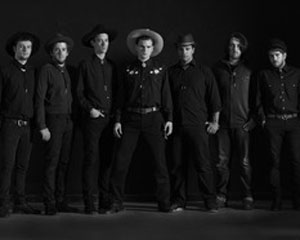
So, what does the ear hear? New Orleans is there. Roots. An indie disposition; if I can phrase it that way. Juke joint sleaze. And more specific influences, acknowledged and not: Cab Calloway; Screamin' Jay Hawkins; Jim Morrison; Tom Waits. This is a band of streetwise alley cats, or youngish men pretending to be such. I say pretending, because it's as much theatre as music, not least thanks to the ratbaggery of lead vocalist and blues harpist, Cyrus Pilko. He is Elvis, Napoleon, Leonard Bernstein and the authorities' worst nightmare folded over into one controversial calzone. To him, a hard-drinking, inveterate gambler, we're all Cadillacs.
Guitarist, banjoist and 'bonist Pablo Martin (nothing if not versatile, eh?) seems to maintain a watchful presence, as if orchestrating every move with his eyes. he looks like a puppeteer, with no strings attached, other than to his guitar and banjo. Benito Martin (no relation?) is right behind, on upright bass.
Off to the side is Harry Goodman, getting his groove on while playing drums, keeping things shuffling along.
Tom Wilkinson also features on banjo and guitar. He blows a mean trumpet into the bargain. He's more directly interactive, especially with Cyrus, who seems to engage him routinely, as a kind of straight man.
In the front line is Marco Nannetti, on tenor & harmonica, who seems sincerely amused and enthused by all that's going on. And next to him, on alto, Jubby Linseed. No, I don't believe he was born with that name either.
Sometimes these bluesmen seem to cross from rollicking raucousness into a kind of punk rockabilly, bleeding-heart ballad, bent bluegrass, or crooked country, when they're not parodying popular song. They brazenly plied their rough trade, with songs like Choo Choo Train, Some Kind Of Woman, Darkest Hour, East Harlem and Where's The Gold? But then they'll hammer out a classic blues, like Little Walter's My Babe. (No wonder Walter plumped for Little; his first name was Marion.) Little Walter, of course, endowed us with a whole new vernacular for the humble harmonica; one which the harpists in Papa Pilko appear to reverentially emulate. Of course, My Babe isn't from the pointy end of Walter's career, but it's still a damn fine, fingersnappin' song, by any other benchmark.
I Demand Satisfaction is one of the numbers from the band's debut four-tracker. It creeps into view with a bassline reminiscent of Peggy Lee's Fever. It remains minimalistic, with razor-edged guitar tweaks, background sax blasts and tom-tommed accents that afford impetus to the tale being related, not the only one to centre 'round a fictional (I assume), evocative Casino Royale. 'Walking on down that old boulevard, just looking for a bar', it begins. As you do. But trouble doubles when you 'spot these girls, through a cold, tinted glass'. Yeah, baby! A man can be down on his luck and get lucky all in the one night.
The foregoing and Bar Fight Blues indicate exactly why you should keep these depraved individuals well away from your daughters and, probably domestic pets. It's B.B. King meets Tom Waits, in a dark alley, well after midnight. But seriously, it's another fine example of the theatrical, storytelling talents of the band, with Cyrus at its centre. 'I got arrested, for something I never did', it begins.You can almost write your own tale from there. It's sassy and brassy, with a trademark sparsity to the arrangement which nonetheless fills the room live.
Speaking of live, much as the Papas are entertaining and eminently listenable in recorded form, there's no substitute for their live energy and the charismatic presence of Cyrus, in particular.
Into The Light weaves another, rather inscrutable tale, of being out of your element in bible-bashing Tennessee. It highlights one of the most interesting instrumental components of the band, in the banjo. And these musicians are nothing if not versatile, swapping instruments frequently. Best of all, they appear to be genuinely enjoying themselves, rather than just going through the motions.
Back Home and Bottom Of The Hill led up to one of the band's real showpieces, The Gambler. No, not the Kenny Rogers one; the Papa Pilko one. But it does bring out their country blues soul. It's arguably their most cohesive piece, wreaking a tale of the havoc, upheaval, wretchedness and destruction that one a one-armed bandit or unpredictable nag can unleash on a weak-willed man, like you or I.
DNA and Papa Pilko have bugger-all in common, musically, stylistically, or in any other way, save for the fact both cleave to being absolutely themselves at all times, so that, whether purveying originals or others' music, it becomes entirely theirs, sine they adopt it and raise it as their very own.
A Papa Pilko case-in-point is their take on Muddy Waters' Can't Be Satisfied. Originally an acoustic blues, Pilko electrify it, in more ways than one, such that it loses nothing of its spirit, yet benefits from its makeover, which manages to meld fierce blues guitar, a steam train beat, blow-your-mind blues harp and a passionate vocal into a visceral sound worthy of, say, The Stones, at their peak. It's a respectful reinvention.
The Chinese might've well been the first nationality to discover Australia (how else does one explain ancient writings concerning kangaroos?). Dutch captain, Willem Jansz, may have made landfall on Cape York in 1606. Burke and Wills may have bloodymindedly traversed the continent from sour to north. But it's intrepid musical explorer Dave Keogh who has helped us discover DNA and Papa Pilko. That, on its own, makes him unofficial Australian Of The Year, in my book.
Eastern Lounge
Papa Pilko & The Bin Rats
with support act DNA
Venue: Roseville Club | 64 Pacific Highway, Roseville
Dates: Friday August 10, 2012
Tickets: $15.00
Bookings: www.easternlounge.com.au