 Photos – James Morgan
The path to A Chorus Line has been, for me, a long one, being one of those musicals that I've always been aware of, but never actually seen. There was, I believe, a production in Sydney when I was a child that I recall seeing advertisements for on television, and a couple of the better-known songs have filtered into my consciousness over the years. An awareness of what it was about developed, a musical about the tribulations of dancers auditioning for a Broadway show. Then, in much more recent times, I saw a fascinating documentary on the subject. It detailed both the original creation of A Chorus Line in tandem with a fly-on-the-wall look at present-day young hopefuls in the process of auditioning for a Broadway revival of the show... which is a rather "meta" bit of layering, given the musical in question.
All that said, I still went into this actual production with a pleasant lack of specific expectations as to how the show would unfold – a bit of a luxury with a musical now considered a major latter-day classic.
What I got was an interesting mix of the surprising and the predictable, both engaging yet somehow distancing. Probably the most notable thing about A Chorus Line is that it very much eschews many conventions of the Broadway musical. Oh, there is singing, dancing and identifiable characters, yes, but as far as a traditional narrative goes... well, there isn't one. Well no, to be fair, there is, but it is simplicity itself: a group of dancers are attending the cattle call for a new Broadway show's chorus line, and over the course of two hours the group is whittled down to the eight who will finally be hired.
The End.
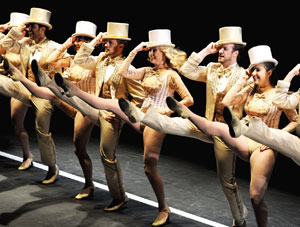
So needless to say, what you are coming to see in this show is not the behind-the-scenes tribulations of a production coming to fruition, no Kiss Me Kate style backstage antics, no unexpected events intruding from the outside world – this is simply the audition. Thus, the drama comes less from what actually happens on the stage than it does from the personal stories of the people involved. As the fleet-footed director Zach (superbly played by Joshua Horner) puts these aspirant hoofers of the Great White Way through their paces, the learning of steps, twirls and high-kicks is interspersed with an unconventional interview technique. Rather than have his prospective cast members recite scripted dialogue for the small measure of additional acting that their roles as dancers will require, Zach asks each auditionee to talk about their lives and what brought them to perform.
It is a small contrivance, perhaps, but it gives us the excuse for delving into this disparate group of individuals and their stories: their dreams, failures, heartaches and heartwarming little triumphs in life. Not all of the 17-strong lineup gets equal focus, of course, some provide just fleeting comic relief while others are afforded show-stopping songs or monologues. Their tales are varied, yet all have one thing in common, something articulated by the opening number of the show – that burning desire for work as a professional dancer – "I hope I get it, I really need this job!".
Some are young and just on their way up, while others are on the way down, desperate to not just fade away in an often harsh job with little future and less security, and one that exacts an inevitable physical toll. For some, enjoyment of A Chorus Line may depend to an extent on one's personal level of empathy towards people who work in the creative arts, particularly for those such as actors and dancers, who are subject to the often dispiriting, sometimes even debasing cycle of constantly auditioning for their livelihood. There is perhaps a tendency for those removed from the production process to default to thinking of overpaid movie stars whining about the paparazzi, while perhaps having a lesser appreciation for the hard work and scant opportunities available to most "jobbing actors" and other professional performers.
If so, A Chorus Line, being a work of fiction based on recordings of real dancers' true stories, may prove enlightening not only to the plight of performers, but to some extent also their motivations. It may be tempting to view many of the characters presented in the show as misfits to some extent, and indeed several do describe troubled pasts and uncomfortable compulsions that drive them to the stage, yet this disparate group of personal tales all have in common the need to perform, and it is an impulse that can be quite fascinating to anyone who has never really experienced that yearning. If nothing else, the show hopes to provide some insight into what kind of things can drive performers to take this path less trodden.
In addition to being an unconventional narrative for a Broadway musical, the production style is equally contrary to tradition. For those who have only seen either the older classics like Guys and Dolls and South Pacific or more contemporary hits like Mamma Mia and Wicked, any expectations of elaborate costumes, mechanised scenery and complex technical set-pieces as standard fare for the medium will be in for something of a shock. "Minimalist" barely begins to describe this show, with performers in leotards and sweat-pants presented on an essentially bare stage with only one background element, a dance studio mirror which periodically disappears from view, and with most "scenic" effects being achieved by simple follow-spots and other lighting techniques. Of course, such no-frills minimalism is entirely appropriate to this slice-of-life, seemingly realtime portrayal of a dance audition – to jazz it up with elaborate effects would be fundamentally counter to the gritty, humanistic identity of the piece.
It does, however make the production, or rather the play itself, seem slightly ill-at-ease in such a large and particularly baroque theatre as The Capitol. Of course, A Chorus Line is a proven major hit and a sizeable venue is thus by no means unwarranted, yet for all the singing and dancing its simplicity of style and intimacy of content ofttimes comes across as befitting a more scaled-down mode of theatrical spectatorship. A lot will depend, of course, on what one values and expects to get out of a "big musical" ticket, yet one can hardly fault the show for peeking into the wings and presenting us with something decidedly different.
All that said, there is something slightly dated about this production. Although I am always the first to defend a show against critiques that it may not be "relevant" (the dreaded "R-Word", as I call it) to today's audiences, A Chorus Line does feel very much a product of yesteryear. Although it may not have been a major trendsetter in breaking down the extravagant tendencies of most Broadway musicals, there is an extent to which one can sense that its pared-back production style and focus on personal narratives to the exclusion of "plot" was surely quite radical in the mid-1970s. Indeed, while the current production does virtually nothing to explicitly "date" itself, one nevertheless feels that it is cut from very much the same cloth of introspection and disaffection that was prevalent in much of the cultural production of America in that period of cultural malaise.
As a result, there is perhaps a danger of this production being perceived as something of a "museum piece", to employ another phrase that I typically abhor which is occasionally invoked by sneering critics. While the idiosyncratic stories of hope and heartbreak which these characters impart are in most respects quite timeless (as, I would imagine, is the portrayal of the audition process for struggling performers), the piece as a whole does feel somewhat "of its time". Personally I have no problem with this, and feel that the theatre scene's compulsion towards updating material is occasionally to the detriment of a good period piece, but in this instance I feel that it is more enmeshed in the inherent style of the show than anything terribly specific to the '70s in its actual content.
This is, in any case, a lively production with some excellent talent involved. There is not a weak member in this large cast, but a few standouts include the aforementioned Horner as the impressively agile director, Hayley Winch as the crass Val, Karlee Misipeka as the oft-overlooked Diana, Debora Krizak as the camp, vampy Sheila, and Euan Doidge as Paul, whose coming-out story still rings with pathos. Anita Louise Combe also deserves a special mention as Cassie, who is very effective in what is probably the closest the show comes to a central character with any "story arc" in the present-day of the audition, being a former leading lady and prior lover of the director, now reduced to finding work in a chorus but humble enough to ask for it.
A Chorus Line is full of energy, laugh-out-loud humour, great dancing and affecting drama. It is also something of a mood piece, relying on mostly unrelated character backstories to populate the loosest of narratives, a smorgasbord of slice-of-life tales from the theatrical world. For those who love their musicals and are intrigued to see a more down-to-earth treatment of the kinds of people who make the more flashy shows possible, it is a rewarding experience.
A CHORUS LINE
book James Kirkwood and Nicholas Dante | music Marvin Hamlisch | lyrics Edward Kleban
Directed by Michael Bennett
Venue: Capitol Theatre, Sydney
Dates: 20 July – 11 August, 2012
Tickets: $129.90 – $69.90
Bookings: http://www.achorusline.com.au