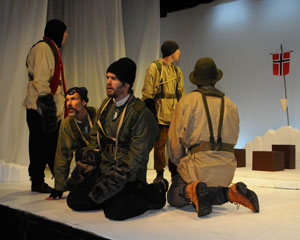
 Scott of the Antarctic lingers in my mind; an heroic relic of my primary school education I think and, as such, one that fills me with caution and suspicion, since the feats deemed heroic then seem to me, on the whole, more like foolhardy, preposterous and emblematic of a pernicious spirit of colonial megalomania. But, having espoused my personal political prejudice, Ted Tally's play, I must say, is a very well-written and deftly constructed one; the last by dint, especially, of intercut scenes and dialogue, of a somewhat filmic nature, which energise the work and compel its audience. This aspect of the play, moreover, has been superbly realised by the cast (not least Roger Gimblett) and directors (Mark Langham & Owen Gimblett) of Genesian's new production.
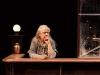
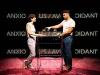
Owen Gimblett has also fulfilled the role of set designer and has applied cunning ingenuity, creating a polar ambience by way of blue washes of light (Michael Schell) and miniature icebergs carved from polystyrene. Cheap as (ice) chips, I imagine, but damn effective. It's a concept that I can well imagine working, given a larger scale and a little more sculptural skill, on a mainstream stage; and being lauded.
Props are minimal (a tent, sled, billy and tin teacups, ostensibly) and nothing more is needed. Indeed, any more would've been overkill; a distraction and detraction from what is truly heroic here, which is the script and Tally's incisive gaze into what makes men and women tick.
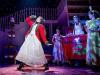
Susan Carveth (given the shoestring budget I imagine was at her disposal, particularly) has shown formidable prowess in seamstressing costumes that are, at the very least, richly evocative of the period and mission.
Welsh accents might be a little variable and, at times, difficult to penetrate, but, as accents go, it's a toughie. All-in-all, a good effort by all concerned. Performances, all-in-all, are strong; physically and emotionally, even if RG's sometimes declamatory style is a little old-fashioned. Nonetheless, given that approach he's Kent Street's answer to Olivier, with a Britisher enunciation that would have seen him almost inevitably working at the ABC, had he been born a decade or two earlier. And the confounding thing is, despite almost parodical lapses into heroic postures worthy of Greek drama, he manages to imbue his character with subtle signs of an aloof and deeply troubled man; here and there, one gets the sense of an insatiably adventurous boy, trapped in an adult body and life. Communicating on this level is no mean feat and is testament to RG's range and capabilities. Besides which, much of Tally's script tends to beg the heroic stance and, perhaps, the almost implicit parody that now comes with it. Gimblett also succeeds in endowing Scott with multidimensionality: loving-but-absent husband and father; authoritarian-yet-conflicted expedition leader; loyal friend and bleeding-heart humanitarian, forced into cruel decisions; reluctant bon vivant; intensely private dreamer; and so on.
Tom Massey is an efficacious antihero, as Norwegian rival for the unholy grail, Roald Amundsen. Loud, proud, built like an ox with a mentality to match, he's the purpose-built, supremely confident, veritably invincible inhuman machine needed to get the job done; uncomplicated, unafflicted by Scott's doubts, insecurities and uncertainties. Psychically, the two are, yes, polar opposites. Amundsen haunts Scott throughout the play; at once a menacing and supportive presence; the Norwegian may be a fierce competitor with an unwavering eye on the prize, but he's also (in Scott's mind, anyway) a figure of camaraderie, a generous big brother Scott can turn to for inspiration and counsel.
Flora Milne progressively eased into her role as Kathleen Scott, portrayed as an unusual, highly individuated, resourceful and headstrong woman, of the ilk one might find in Austen. (Austentatious, if you will.) At times, she risked near inaudibility, but otherwise showed engaging finesse.
James Moir is robust, in every sense, as the compassionate doctor, 'Bill' Wilson, with little more than morphine and a good bedside manner at his disposal to get the crew through. Sam Ryan is good, too, as the diminutive-but-defiant 'Birdie' Bowers, who walks twice as far as his comrades, by dint of his shorter stride. Michael Sydes is charged with the difficulty of playing the gangrenous 'Taff' Evans, but does so convincingly: we almost touch the sides of the horrible admixture of anguish, denial, struggle and sheer excruciation of his dramatic demise. Jack Wieczorek's 'Titus' Oates may be easy to dislike, early on, thanks to his uncompromising attitude to Evans' condition, yet it's a tribute to his skill as an actor that we can't help but feel for him, either, as he succumbs to the poetic justice of the very same kind of painful end.
This is about as good as amateur (and Genesian) productions get and I can barely imagine a professional one managing too much better with characters that are, now, out of their time; as exotic, remote, inaccessible and unreal as the south pole itself, seen through the ethereal prism of the 'hellish' southern lights. Terra Nova harks back to a time when destiny came as a birthmark.
Genesian Theatre presents
Terra Nova
by Ted Tally
Directed by Mark Langham & Owen Gimblett
Venue: Genesian Theatre | 420 Kent Street, Sydney
Dates: 14 January – 4 February 2012
Times: Friday and Saturday nights @ 8pm, Sunday matinée @ 4.30pm
Bookings: www.genesiantheatre.com.au