 Thrillingly impressive, flawed in places yet unquestionably epic. These are but a few of the ways you could describe Ben-Hur: The Stadium Spectacular, but the most appropriate term is right there in the title, this show is spectacular.
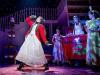
As you have doubtless heard already from the media blitz, this mammoth production is touted as the largest theatrical event ever mounted in Australia, and they may well be able to back up this bold claim. Featuring some 200 performers with the vast, dirt-covered Olympic arena as their stage, this show is a pageantry of live horses, gladiators, faux naval warfare, huge mobile sets and legions of soldiers, slaves and pirates, so there can be no overstating the grandiose scale on which this tale is told.
The emphasis, however, is firmly on the spectacular rather than the tale in question, with the sprawling story reduced down to its most basic framework. In particular, the dialogue has been made as minimal as possible, which is not a bad thing per se, but does make the story seem surprisingly thin when pared back to the barest bones of its plot without imparting much of the accompanying characterisation or tone that gives a drama its flesh. Compared to a stadium-staged opera spectacular like Turandot, you will be disappointed if expecting an engrossing narrative, but if the show is embraced on the level of “spectacle” and viewed more like a circus, you’ll be in the appropriate frame of mind.
Perhaps the only real casualty of this simplification of story detail to the bare minimum is that it makes the Jesus scenes seem extraneous. The 1959 film and the original book are very much in the tradition of the parallel novel, in which Ben-Hur’s life intersects with that of Christ but he does not realise the significance of this seemingly minor character in his own story until the end. In these earlier versions, the appearances of Jesus initially seem subtle and almost incidental, but in the context of this arena show subtlety is really not the goal, and the narrative is instead rather abruptly halted for the Messiah to make his cameos, which might seem a tad random to anyone unfamiliar with the story.
In particular, the Via Dolorosa scene that concludes the show is presented in a confusing fashion that conflates it with the colony of lepers sequence, and no actual crucifixion is depicted. Instead, Jesus is seemingly mobbed by the lepers and then disappears in the resulting storm, as though devoured by a ravening horde of zombies who are then miraculously cured from the eating of his divine flesh. The absence of any concluding narration compounds the opacity of this conclusion to any attendees who don’t already know the plot.
But these quibbles aside, what we’re really here to see is grand action, and this bubbles forth in abundance. The sheer number of performers that run into the stadium from scene to scene is something to behold, and for those used to an “army” being depicted on stage by two to four actors, seeing this huge throng of Roman Legionaries and the like assembled is a rare treat. The mammoth cast appeared well-rehearsed and each elaborate sequence came off without a hitch, including rapidly assembling a life-sized Roman galley for the naval battle, driving slaves across the desert, and a huge gladiatorial wrestling competition invoking the interactive cheers and boos of the vast audience. For such an enormous endeavour, the show was remarkably tight (short, even) and never really lagged, charging from one impressive tableau to the next.
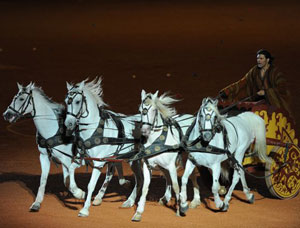
Undoubtedly though, the highlight of the production was the chariot race, the signature set-piece of every incarnation of Ben-Hur’s story. With a half dozen chariots each pulled by four magnificent and well-trained horses, the race was genuinely thrilling, with fast turns and wheels flying off on cue as the various competitors meet their demise, even staging the villainous Messala being fatally dragged behind his mounts. While the production includes many astonishing sights, nothing compare to this. After all, how often in your life are you going to see real live chariots racing around an arena?
However, for all the slickness of the production, and even embracing its nature as a spectacle-driven show, this Ben-Hur does have its wobbly bits. For reasons that escape me, the dialogue is virtually all pre-recorded by some incredibly awkward voice-actors, which the live performers mime to this stilted delivery. Perhaps this was simply due to the importation of most of the original French leads, but it really didn’t work, especially when contrasted with the dulcet tones of Russell Crowe’s narration or the excellent work of local improviser David Callan, the only actor speaking his lines live while calling the race and the gladiator match. And speaking of Crowe, for all the marquee value associated with putting his name on the local incarnation of this production, he was unfortunately under-utilised, with his pre-recorded narrative links few and far between, and disappearing altogether towards the show’s baffling conclusion.
Still, ultimately, this is an amazing theatrical event, all problems aside. Is it worth the steep ticket costs? Probably not the top-end $300 seats, but absolutely at the lower price-points.
Is it truly the show of shows? Perhaps not quite, but for sheer scope, scale and spectacle, it is probably without peer, and surely an experience that will stay with you for a long time to come.
STADEFRANCE Live Events presents
BEN HUR – The Stadium Spectacular
Director Robert Hossein
Venue: ANZ Stadium, Sydney
Dates: Friday 22 and Saturday 23 October, 2010
Info: www.benhur.com.au