

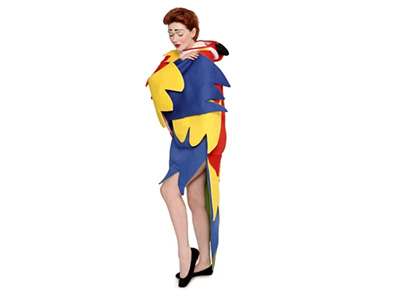


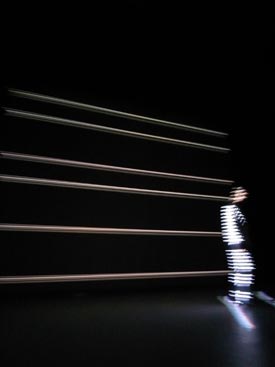
 Left - Hiroaki Umeda in Adapting for Distortion. Cover - Hiroaki Umeda in Adapting for Distortion. Photos - Alex
Hiroaki Umeda’s offering to this year’s Melbourne Festival is a show that is more movement than dance, with sound effects rather than music, and a light show with no set. The Tokyo based performer, working with his company S20, presents two solos. The first, Adapting For Distortion, opens with a bare stage and darkness. Two gold, star-like, lights twinkle in the background. There’s the sound of what could be crickets, then the heavy stream of water. But the stars quickly multiply, and then comes the uncomfortable throb of artificial and unrecognisable noises, and any sign of tranquillity or the natural disappears.
Eventually Umeda comes on to the stage, and for the majority of this piece he dances against white and black lines, a matrix of lights projected behind and on his body. The lines divide his torso, and along with the vibrations, seem to pulse through him. He is less recognisable as a human dancer and instead becomes a bulging mass. With the lights moving quickly and erratically, like strained rubber bands, they seem to pull his limbs to be an extension of both the lights and darkness. He could be moving slower than he seems, or faster. Amidst this type of optical illusion, the lighting becomes, in a sense, the star performer.
The most visually interesting and emotive moment comes when Umeda stops dancing, arms outstretched to the side. Having just danced for a period of time, he is breathing heavily. Again, the black and white lights divide him but this time they exaggerate the rise and fall of his chest. Finally, his form shows signs of being human.
Given that the two pieces in this show run for roughly only half an hour each, and there seems to be considerable periods where Umeda is not moving in the first, for the audience at least, the length of the intermission between them seems surprisingly and frustratingly long. However, the lighting in the first piece could again have been deceptive, and from a dancers perspective, the respite may be physically necessary.
And so, with the second piece, Haptic, there is an air of expectation. Again there is just a bare stage but the overpowering light show has been replaced with a more traditional lighting design, in a predominant palette of blue and green, and at one point red. However, the soundtrack is still confronting. Much like the sound made with the turning on of a stereo with the amp turned up and getting interference, it is more than a little unsettling.
Despite this, without the lights to distort Umeda’s body, the audience is able to really see and appreciate the skill and control involved in his carefully choreographed and timed movements. The majority of these come from his lower body, the shuffling of legs, feet and ankles. The speed at which his lower limbs move makes them appear disjointed from the rest of his body, giving him a curiously fluid, yet still sub-human quality. In this piece, unlike the first, when Umeda strikes a pose, perfectly still for quite some time, he is really able to display his balance and control.
In consideration of the show’s programme notes, one can appreciate what Umeda is looking to highlight in each piece. Particularly in Adapting for Distortion, the disturbing way the body can seem to morph into its surroundings is an intriguing concept. Yet these are pieces that in their current form, with just one dancer on stage, run far too long. Umeda’s choreography is undoubtedly more calculated, varied and complex than it may first appear, but its repetitive nature is inescapable. One can’t help but make comparisons to recent works by Chunky Move. Their shows Mortal Engine and Black Marrow featured similar dance movement, lighting, and soundtracks, but they also featured more than one dancer. It is this multiplying, and at times interaction, of movement from the dancers, that in Chunky Move works create a great deal of the visual interest. As a dancer and choreographer, Umeda is quite something, but Adapting For Distortion and Haptic fail to supply the sensory and visual feasts that they perhaps should.
2010 Melbourne International Arts Festival
Adapting for Distortion & Haptic
Hiroaki Umeda
Venue: The CUB Malthouse, Merlyn Theatre
Dates: Thu 14 – Sat 16 Oct at 8pm, Sun 17 Oct at 5pm
Duration: 1hr 5 min with interval
Tickets: $45 - $25
Bookings: Ticketmaster 1300 723 038 | www.melbournefestival.com.au | M-Tix 03 9685 5111 | www.malthousetheatre.com.au
Helios begins with the ancient Greek myth of Phaeton and gently pulls it into something recognisably human: school buses, mixtapes, teenage dares, grief, fathers, first kisses and one bright gold car.
21 May 2026
Canberra
4 May 2026
Melbourne

26 April 2026
Sydney
Latest Reviews
Adapting for Distortion & Haptic | Hiroaki Umeda
- Details