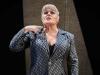
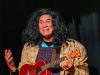
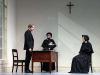
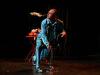
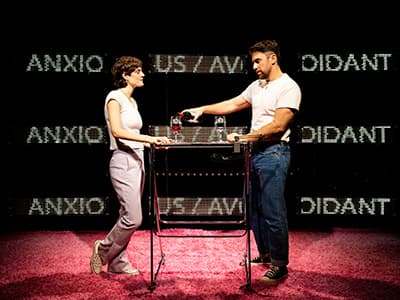
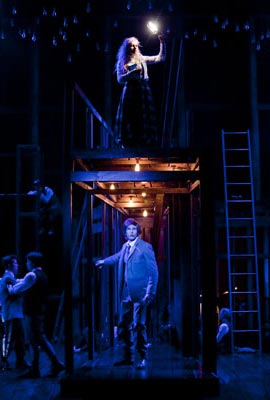
 Left - Clare Bowen and Andrew Hazzard. Cover - the cast of Spring Awakening. Photos - Brett Boardman
A Sydney Theatre Company rock musical? There goes the theatrical neighbourhood! Another concrete example, presumably, of the freeing influence of dynamic duo co-artistic directors Blanchett & Upton, Spring Awakening has harnessed the youthful energy of an upcoming generation of performers, virtual unknowns until getting this gig, the proverbial big break. It might be a contemporary outing, but, in essence, it has its roots in a late 19th-century play, by German, Frank Wedekind. (He was also known as a copywriter, for Maggi; actor, singer and circus performer; but that's purely incidental.)
Wedekind was either eerily prescient of the subsequent invention of the teenager, or merely documenting a reality still lacking a brand, since his was a coming-of-age story. A man after my own heart inasmuch as being a staunch, fierce critic of attitudes bourgeois and hypocritical, especially around the vex of sex, he has been widely-acknowledged as a pre-eminent influence on the development of epic theatre. For his time, I imagine, he must've been one hell of a courageous stirrer, too, putting the rational cat amongst the robotic pigeons.
The musical adaptation has picked up 8 Tonies, including for best book & best musical, and has attracted a number of other gongs to boot. The tale of literary agent, playwright & lyricist Steven Sater's life and meeting with collaborator and composer Duncan Sheik would almost be worthy of a musical in its own right, but that's another story. Since its Broadway breakthrough just a few years ago, their musical has toured the world, 'de force', if you will. The reasons are obvious. It's been deviously scored, to traverse the ups, downs and in-betweens of young love, unbridled desire, consummation and its not always happy aftermath. From strident anthems to bursting ballads, the emotional trajectory is evoked, well, consummately.
But the best story, from an Aussie point-of-view, is the emergence of director Geordie Brookman and an outstanding, youthful cast. Brookman might be known to you, for example, as director of Company B's Baghdad Wedding, a gratifyingly accessible work which largely succeeded in its not-so-hidden agenda of presenting a broader take on Iraq and Iraqis. Or B Sharp's well-received Tender. Or numerous others. In fact, as writer, producer, dramaturg and director, on stage and film, Brookman has been almost everywhere, man: Adelaide (where he graduated from Flinders drama school less than a decade ago), Sydney, Melbourne, Brisvegas, Perth and Edinburgh. What's more, he's been engaged by STC before, as an affiliate director and currently occupies the role of associate director at the State Theatre of SA. In short, his is the sort of determined talent that's enjoyed a trajectory that saves artistic penis envy from becoming redundant; not that there's any threat.
Brookman and his performers, who broke through highly-competitive open auditions (1,400 contenders, I think Cate said) to secure their roles, have managed to capitalise on the intrinsic strengths of Sater & Sheik's musical: embodying the terrible and wonderful, exhilarating hormonal rush that is the spine-tingling tumult of adolescence. Of course, not everyone gets through. Even for up-and-coming geriatrics like yours truly, when done with this level of conviction, it's not so very hard to reawaken parts of oneself only Heineken might otherwise.
Amazingly, I found myself still in touch with the glandular fever that is the first flush of attraction; the attendant confusion, embarrassment and flight impulse. As such, I find myself, probably not for the first time, as one (up to a point) with The Bard: "I would there were no age between ten and three-and-twenty, or that youth would sleep out the rest; for there is nothing in the between but getting wenches with child, wronging the ancients, stealing, fighting"; though ol' Bill seems to lean towards the parental outlook whereas Wedekind, Sater & Sheik clearly favour and empathise with the tortured teen, as do I. It's hard not to when, from the start, key female protagonist Wendla pleads, in song, to her mother, that there's no bliss in ignorance, and no love or understanding where it's allowed to prevail, only pain: "Mama who bore me; mama who gave me no way to handle things, who made me so sad".
This in punked-up period costume (designed by Tess Schofield) in a dark, timber set (courtesy Anna Tregloan) that seems as rustic and restless as the characters who inhabit it. It serves as schoolroom, church, reformatory, graveyard, living room and much else, relying little on props, instead flattering the imagination of the audience by falling back on the theatre of the mind. Lighting is dimly incandescent, if not nearly as much the latter as the ensemble, which takes a powerful, moving score to its emotive zenith. A note, however (for Niklas Pajanti, the lighting designer): while the handheld miners' lights were an innovative idea, they were perhaps overused and require the actors to be more adept with their deployment, as there were moments when the audience was semi-blinded while the action was inadequately illuminated.
The band was cleverly concealed at the back of the set, which featured ladders and numerous entry and exit points, allowing the full dimensions of the space to be exploited. Much of the cast was often on-stage at once, in a staggered arrangement both aesthetically balanced and effective in providing a dramatic depth above, below, behind & beyond the central action.
There was no shying away from the potency of sexual urgency, which was depicted with disarming frankness, yet was never in any way confronting. Similarly, a gay love scene was tender and touching and I'd be genuinely surprised if it would ruffle even the most doggedly homophobic onlooker. Love scenes that ring with sincerity, as well as physical and emotional authenticity are challenging, at the best of times. Suffice to say Brookman has pulled it off with as much aplomb as the masturbatory scenes. Death is handled with minimum melodrama, too, which is especially refreshing in a musical that draws on epic theatrical traditions. In short, I've nothing but praise for the man at the helm, who would seem already to sport the finesse usually only associated with a much more seasoned director.
I found that some of the lyrics were lost, depending who was singing them, but that might be as much an indictment of my longtime rock-assaulted hearing as anything else.
For mine, the troubled Moritz, played by Akos Armont, was in many ways, the richest, fullest character, an everyday Jimmy Dean, or Jeff Buckley: a sensitive soul plagued and pommeled by authoritarianism, rigidity and a brutal religious & social milieu. Armont made the most of it, with his windswept hair and charismatic, insistent presence.
Clare Bowen, as Wendla, could have succumbed to a narrow, 'blonde bombshell' interpretation of the role, but manages to eke out subtleties and nuances that make her, also, easy with which to identify and sympathise; while Andrew Hazzard's commanding Melchior is heroic as the principled, free-thinking rationalist, courageous and outspoken, as well as compassionate. He could've become overly Christ-like, if not for his capacity to express self-doubt, despite his certainties and convictions. Melchior serves the broader purpose of tearing a hole in the roof of the church and its aura of and shameless trade in fear and intellectual subjugation. Not for him the sublimation of desire, which is wreaking cruel havoc all around him.
There are really too many noteworthy performances to cover: suffice to say, for mine, a couple of the finest singing voices were somewhat in the background: Nicholas Kong's (Otto and Ulbrecht) & Angela Scundi's (Ilse).
Berynn Schwert and Helen Dallimore took on all the male and female adult characters and were a versatile highlight.
Special plaudits are reserved, too, for choreographer Kate Champion, who has absolutely earned her surname, in gifting her cast with a vocabulary of expressive movement that is heart-rending in itself. It is a true test of taste in a choreo to refrain from interpolating dance, as such, instead stepping back and looking at what the work as a whole needs, then applying the discipline to ensure it is given that and nothing in excess. Bravo! The band, also, under the direction of Robert Gavin, exhibited mastery and a rare dramatic sensibility, translated into unobtrusive yet indispensible dynamics.
It's hard to separate which is the triumphant hero of this musical: story, or score? Of course, in the best musicals, the two are synergistic and inseparable, and this is the case here. Again, Geordie Brookman has woven all the threads into an emotional tapestry that has real depth and, in so doing, delineates and defines the difference between what is merely good, theatrically, and that which is memorable. Moreover, he has managed, I suspect, to genuinely Australianise the work, giving a just-so streetwise edge, while detracting not a jot from its intent and integrity and, indeed, the intent and integrity of Wedekind's original play. An admirable, delicate and dangerous balancing act.
This one will live on, vividly, in my heart, as well as memory.
Thought is suspect
And money is their idol
And nothing is okay unless it's scripted in their Bible
But I know
There's so much more to find
Just in looking through myself, and not at them. - Melchior, All That's Known.
Sydney Theatre Company and Medina Apartment Hotels in association with PowerArts present
Spring Awakening
Book and lyrics by Steven Sater | Music by Duncan Sheik | Based on the original play by Frank Wedekind
Directed by Geordie Brookman
Venue: Sydney Theatre, 22 Hickson Road, Walsh Bay
Dates: 4 February - 7 March 2010 (season extended) 2010
Time: 7.30pm
Tickets: $40 to $90
Bookings: 02 9250 1777 | sydneytheatre.com.au