



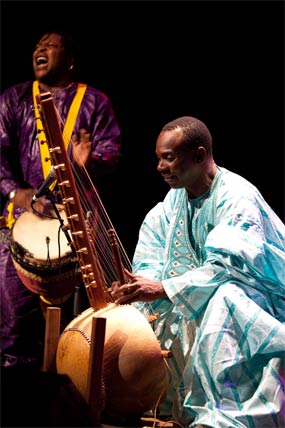
 Photos - Jamie Williams
The Beeb has put Toumani Diabate on a pedestal, right up there with the obsessive genius of Glenn Gould or Rostropovich: 'the sort of musician you only encounter once or twice in a lifetime'.
In a tight 90-odd minute set, Diabate, the 71st generation, in his family, of father-to-son kora virtuosos (with the 72nd generation assured, in the form of his 18-year-old son), justified the veritable deification; with the help of The Symmetric Orchestra, which amounts to an extraordinary pan-African band in understandable awe of its demanding master, notwithstanding the comparably peerless talents of which it's comprised.
Not only Diabate, but most of the band are authentic griots, a class, or caste, of hereditary musician-historians, or musicologists, which has no equivalent in the West.
Diabate's father, Sidiki, was known as King of the Kora, and Toumani has rightly inherited the crown, making him one of the most important and influential musicians in Africa. In 2003, this was officially confirmed, with his win of the Tamani d'Or, for best kora-player in the world.
TD has enjoyed much success in the studio, including the Grammy award-winning collaboration with the almost inestimable, sadly missed, Ali Farka Toure, In The Heart Of The Moon.
We waited with bated breath, once the houselights faded to black, for the appearance of TD & TSO: the suspense nearly killed, but the music that was forthcoming thrilled.
Beginning with a furious flurry on the balafon (a rustic, tuned percussion instrument in the same family as the xylophone, vibraphone, marimba and glockenspiel, with up to 21 keys, matching the kora's 21 strings), Diabate and co launched their 'jubilant polyrhythmic party' (as the Village Voice referred to it).
It's a rare privilege to be able to report an exceptional mix, with all instruments having their own space and clarity. if it can be done on a Friday night in Parramatta, why not every night, everywhere?!
Thus, the kickdrum, for example, was kickarse, thumping in one's chest as surely (one hopes) as that humble, hardy pump that sustains each of us, for a time.
There were some showy flourishes on the djembe, too, before the band settled into some superlative grooves, informed by the music and culture of African nations from Burkina Faso to Ivory Coast; Guinea-Bissau to Niger; not to mention flamenco, especially as channelled by one of the robust singers.
One would be very hard-pressed indeed to discover better musicians, or musicianship, on any instrument in the lineup, from mellifluous electric guitar to distinctive ngoni (a canoe-shaped, plucked lute).
The whole effect is like driving a big V8: much of the time it just burbles and bubbles along, with torque, urge and latent power; it's only when one puts the pedal to the metal that it really cooks. Yet it's pulse-quickening just to know it's there. And there's so much there: more layers and textures than the delicate Middle eastern pastries in which we indulged after the concert; with just as much honey. This is the finest musical embroidery; but never overdone.
Diabate presides, a terrifying presence, commanding his musicians in a way that would make Ellington, or even Buddy Rich, blush. A nod, or raised hand, can silence one of the band's number, or elicit an accent on snare. He challenges and ekes out the utmost from all on stage, pushing them to their very limits and just a bit beyond, with demanding call-and-response improvisations that must surely raise a sweat. When he leaves the stage, one can almost sense the relief, grateful though the musicians might be for the opportunity to play in such rarefied company.
To his immense credit, Diabate still has the integrity to live in Bamako, where he was born, and is quick to proudly defend the goodness of Africa, and tout its cultural depth & intensity, of which he is, of course, a key exponent.
Diabate's own playing allows plenty of room for his collaborators, but one he gets going, it's blinding: a crystalline cacophony of frenetic phrases, spilling from just four fingers (the left thumb plays the bassline, the right melody, while the forefingers improvise); a seemingly impossible feat of mental discipline and independence.
Whether you're African, Spanish, a jazz fiend, a dance enthusiast, or someone of broad musical taste, it's hard to imagine your heart, hands and toes could fail to be moved by this magical music. The man himself is as quick to acknowledge Elvis as Youssou N'Dour as inspirations, but while we may single out styles using Western vocabulary and nomenclature, Diabate will tell you for Malians it will resonate as 'the roots', which tends to indicate it was all there, in West Africa, from the very beginning. Exuberant, enchanting and exhilarating!
2010 Sydney Festival
Toumani Diabaté
With the Symmetric Orchestra
Venue: Riverside Theatre | cnr Church & Market Sts, Parramatta
Date/Time: January 15 at 8pm
Duration: 1hr 30mins, no interval
Tickets: $65 / $55
Bookings: Riverside Theatre 02 8839 3399 | Sydney Festival 1300 668 812 | Ticketmaster 1300 723 038
With the Symmetric Orchestra
Venue: The Domain
Date/Time: January 16 at 8pm
Tickets: FREE
Playing The Mandé Variations
Venue: State Theatre 49 Market Street, Sydney
Date/Time: January 17 at 8pm
Duration: 1hr 15mins, no interval
Tickets: $70 / $60
Bookings: Ticketmaster 1300 723 038
Web: www.sydneyfestival.org.au/diabate