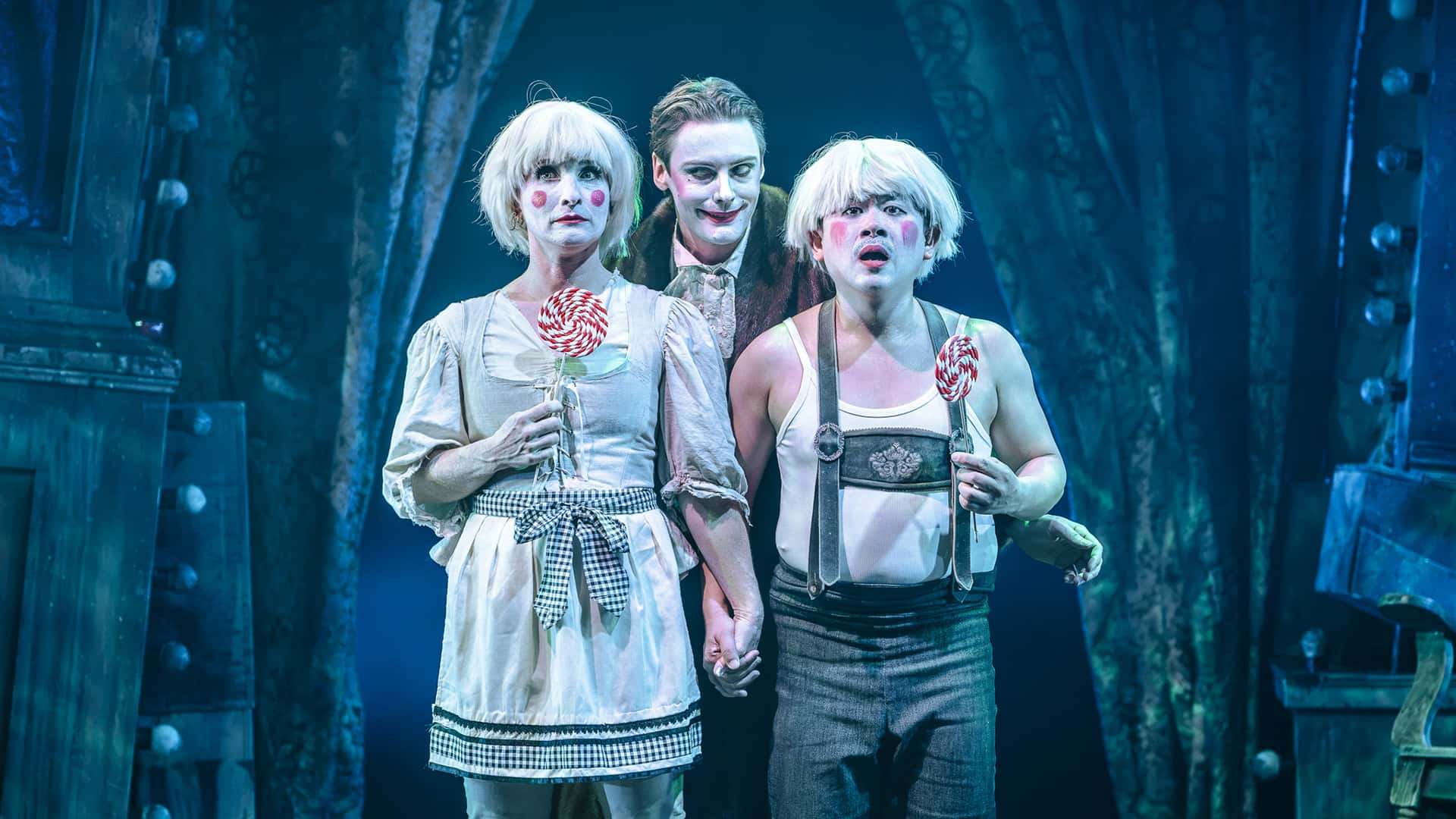
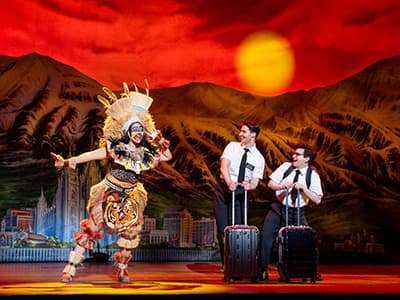
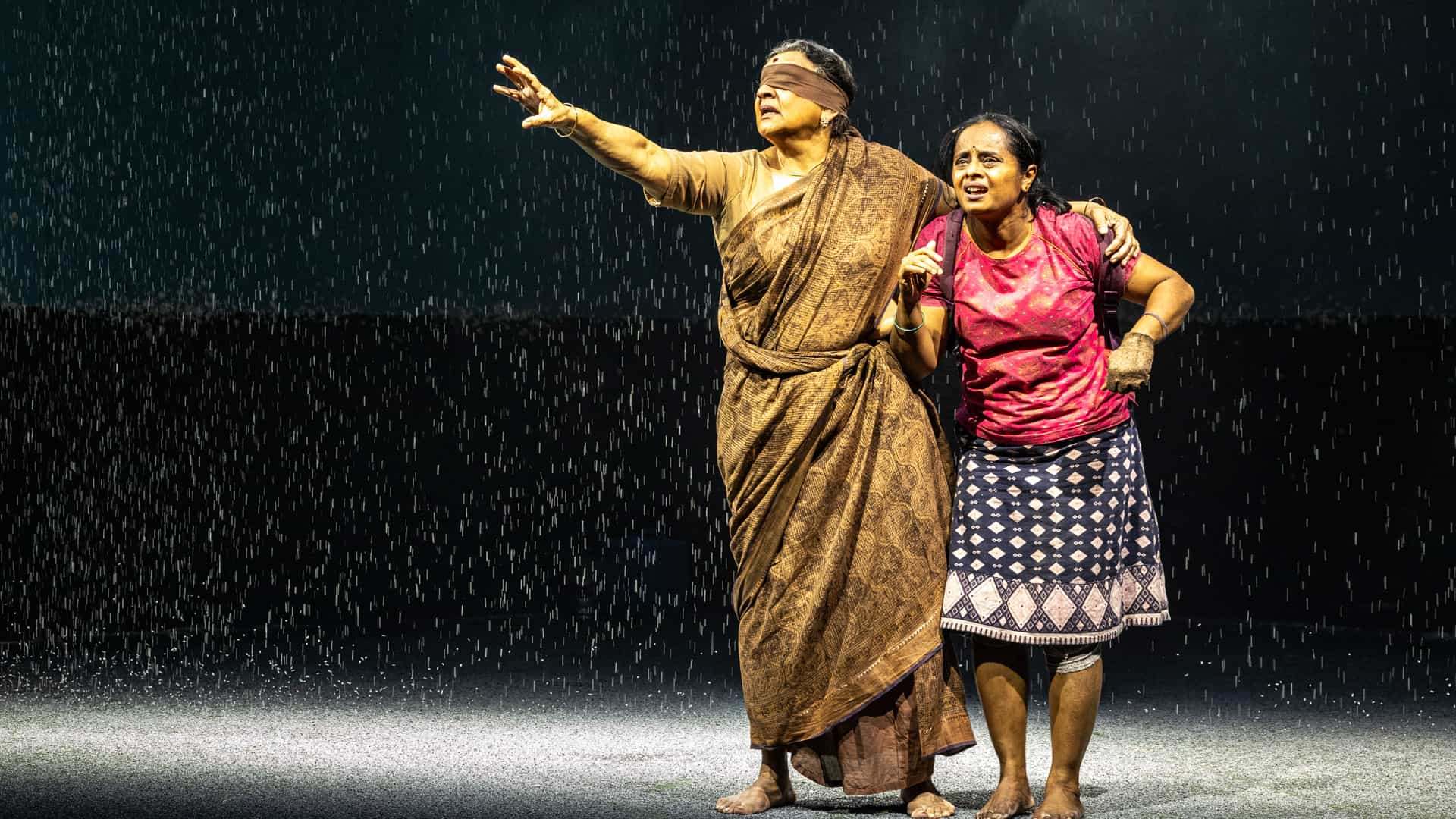

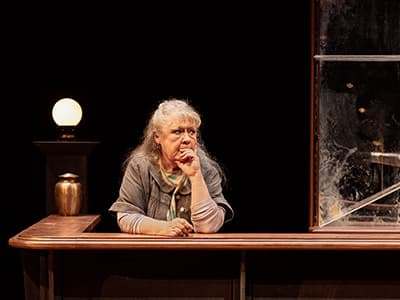

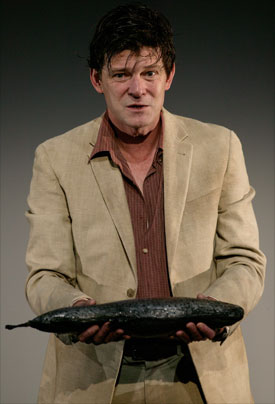
 Left - Neil Pigot. Cover - Michaela Cantwell and Neil Pigot. Photos - Jeff Busby.
It lands with a thud at Gabriel York’s feet – a miracle, an epiphany, and the first sign of hope – a dirty great fish, straight from the sky.
Moments like this; seemingly random and dreamlike, yet entirely believable, make When The Rain Stops Falling a work that plays on the mind and the emotions, with greater force than one could ever expect. It is a work in which writer Andrew Bovell explores the irreparable and far-reaching damage that comes from a life where emotions and yearnings are contained and questions are left unanswered.
When The Rain Stops Falling’s brilliance comes from its form as much as it’s content. Bovell, has admitted that he has “a particular interest in unexpected connections” and in this work, as he did in his play Speaking in Tongues, later adapted for the screen as Lantana, he uses these to create great tension and twists, between and within the individual stories.
The play follows the stories of characters from London in the 1960’s to Alice Springs in 2039. Each has lost or is in search of loved ones, and it demands the full attention of its audience for the links between them to become apparent. Whilst it is a work that rewards its audience for its concentration, context is in some ways irrelevant, as there are many moments where one cannot help but become engrossed in the enormity of the loss and melancholy felt by these characters.
There is more than one common thread throughout these stories, but in each the rain is unrelenting and water is something to be feared; it has the power to make humans commit unspeakable acts and it has the power to take human life. Composer Quentin Grant’s pre-recorded track makes the sounds of the rain outside a continuous and unquestioned reality and his live piano playing on the side of the stage, whilst at times a little too keen to pre-empt a dramatic event, works along side it to create great tension.
Designer Hossein Valamanesh faces a considerable challenge in designing a set that will accommodate the transgression between various locations and time periods – at times more than one at once – and he has successfully done so largely through employing layering effects and repetition. At first there are opaque screens and the various ghostly characters move behind, between and around them until all the performers congregate at a large dining table. It should be a place of family celebration and discussion but as the characters sit there without interaction, it becomes clear that the dinner table will become a place of unspoken words, regrets and secrets. At various times, text indicating the year and location of each scene are projected onto the same screens. It is in some ways necessary in order for the audience to following the narrative with more ease, but in its modernity it is rather at odds with the mood and aesthetics of the play. There is also some manual manoeuvring of sets, which, in the state-of-the-art Sumner Theatre, is more obvious than it might otherwise be.
The set, in tandem with Niklas Pajanti’s lighting, is at its most effective when the story moves into the expanse of the Australian desert and the sand dunes of the Coorong. Here the stage is left relatively bare with the placement of just the integral elements; a tree and Uluru, both of which hang upside down from the ceiling and are yet more signs that there is little in this play that is as one would expect. In the vastness and isolation of the Australian outback, life has been turned upside down.
Director Chris Drummond has pushed his cast to their absolute limits and the performances of Neil Pigot, Kris McQuade, Anna Lise Phillips and Carmel Johnson particularly, bring the theatre to the edge of their seats and potentially to the verge of breaking down.
As it does its characters, this is a work that that will test its audience’s resilience to the very end.
Melbourne Theatre Company in association with Melbourne International Arts Festival presents
Brink Productions'
WHEN THE RAIN STOPS FALLING
by Andrew Bovell
Director Chris Drummond
Venue: MTC Theatre, Sumner
Dates: 7 October to 22 November
Opening night: Monday 12 October at 8:00pm
Tickets: From $58.20 (Under 30s – $30)
Bookings: MTC Theatre Box Office 03 8688 0800 or mtc.com.au
There is no single villain, only the accumulation of ordinary disappointments that eventually becomes unbearable.
28 September 2026
Adelaide
27 September 2026
Sydney

12 September 2026
Sydney
14 September 2026
Melbourne
3 September 2026
Sydney
Latest Reviews
When The Rain Stops Falling | Brink Productions
- Details