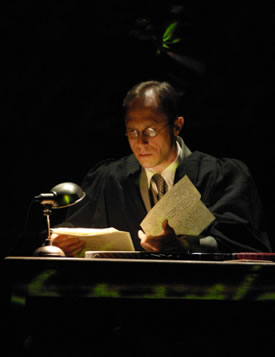
 Photos - Robbie Jack
I have a confession to make: this may be a slightly biased review. When I lived in London I saw Complicite’s previous production, Mnemonic, about 30 times. I was a card carrying usher at Riverside Studios and my personal debt, in exchange for life changing theatre, was to pick up tissues, plastic cups and half-ripped tickets at the end of each show.
Consequently a brief friendship sprung between myself and the company’s founder and director, Simon McBurney. I was a drama student living in London’s east end and the friendship was as blessed and unlikely to me as a heatwave in the antarctic. I was working on an idea for a book and Simon graciously gave me his time and advice on countless occasions. Then life moved on, as it does, and while McBurney may vaguely recall my acquaintance, his professional influence has resonated deeply throughout my life since.
So it was with trepidation and excitement that nearly a decade later, I saw A Disappearing Number at the Sydney Theatre. Thankfully, it lived up to expectations - not only for me, but for the 900-odd theatregoers packed in on preview night. The applause nearly was embarrassing, if it weren’t so warranted. I lost count after four curtain calls.
There’s a quote in A Disappearing Number that captures the show’s essence. Short of having a dictaphone strapped to my seat, it went along the lines of, “we instantly recognise beauty. We may not understand why something is beautiful, it just is.” A Disappearing Number is truly beautiful theatre.
Its beauty celebrates numbers, because “life is entirely built on prime numbers.” Metaphysical mathematical equations fly across multi-media screens (and above our heads) and the result is mesmerising. You needn’t understand the existential equations to appreciate their beauty.
Visually striking, A Disappearing Number seamlessly promotes the sliding doors relationship between the various infinities, which comprise our eternal bond within the past, present and future. Transparent screens divide scenes, upon which human shadows are cast against the projected backdrop of fleeting numerical equations - calculations, which we learn, define the essence of life.
The production’s roots are embedded in the true story of uneducated genius Srinivasa Ramanujan, an Indian who is given the opportunity in 1914, to work on his theorems at Cambridge University with the famous mathematician G H Hardy.
Hardy purports that "a mathematician, like a poet or painter, is a maker of patterns". Ramanujan’s mathematical patterns converge with life and he definitively proves that infinity equals 1/12 (yes, really) and that we are forever connected to our past, present and future, along a shared continuum of numerous infinities. We are forever connected - “even with those who are absent.”
Set against this numerical narrative, the relationship between modern day mathematics professor Ruth (interestingly characterised at times as a female version of McBurney) and her brash futures dealer husband, Al, is explored.
Ruth is so inspired by Hardy and Ramanujan’s work, that she travels to India, to the place where Ramanujan died, to connect more deeply with his past. Meanwhile, her husband, the brilliantly dislikeable futures trader, has never returned to the place of his past - his Indian roots – and a place of “amazing beauty”, according to Ruth. Al is eventually forced to return to his roots in India, the direct result of Ruth’s actions. The message is clear: our shared past directly affects our shared futures.
It isn’t until later in the show, that the stagecraft becomes less involved with (what is at times breathtaking) multi-media displays and more involved with simple objects like a chair, or even white bed sheets to represent snow-capped mountains. In Complicite’s deeply imaginative world, a simple prop can represent a thousand different objects. It’s during these moments of shared understanding that our minds rewind to a childlike place of inspired imagination - and beautiful theatre happens.
In Complicite’s world, the divide between stagecraft and the story line is invisible. It’s hypnotic to watch scenes dissolve while others converge, apparently from nowhere. The sophisticated simplicity of the human form is celebrated and stark staging focuses our mind on the main event – a universally shared story of life, death and love.
A Disappearing Number leaves you tingling with the prospect that for a fleeting moment you may have just understood the meaning of life. Then the eureka moment snaps off as house lights go up and the curtain calls. Much like a good book, A Disappearing Number will leave you wanting more, long after it’s finished.
Complicite
A Disappearing Number
Venue: Sydney Theatre, Walsh Bay
Dates: 19 November - 2 December
Tickets: Adults: $85, Concessions: $65
Bookings: www.sydneyoperahouse.com
Sydney Reviews
A Disappearing Number | Complicite
- Details
- Siobhan Doran
Most read Sydney reviews

A Mirror | Belvoir
Steeped in meta-theatricality, A Mirror prompts us to reflect on the status of storytelling, of its place in creating a culture, its manipulation into myth, its power to prick and to prod.
Stage Kiss | New Theatre
There’s a palpable playfulness to these performances, disciplined, drilled and delightful. There’s fire, bite and fun and lots of kissing.
Simone Young conducts Mahler’s Song of the Earth | Sydney Symphony Orchestra
Young, O’Neill, Ionis, and indeed every member of the orchestra understood how to let this music crack open the psyche, yet hold us there in ways that can transfigure our souls.
As You Like It | Fingerless Theatre
Wit and beauty, pride and sorrow, self disgust and merriment
My Brilliant Career | Sydney Theatre Company
Based on an Australian literature classic, My Brilliant Career is destined to become an Australian theatrical classic.
A gifted embroider of words, Friel combines soft lyricism and hard meaning in his play, a tragical comical historical pastoral on a spree and spoiling for a spirited spar.

As befitting a work honouring the inventor of the printing press, Gutenberg! The Musical! is enamoured of words, drunk on words, intoxicated with text, mad for the metaphor, passionate for the pun.