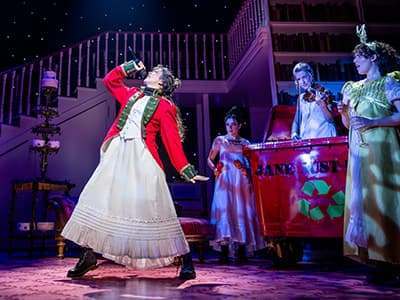
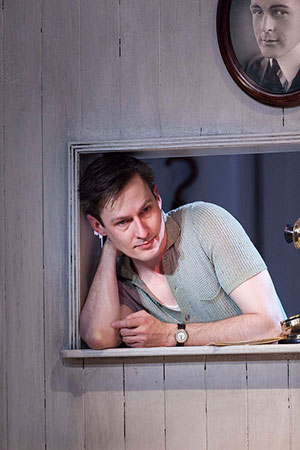
 Left – Luke Mullins. Cover – Pamela Rabe. Photos – Brett Boardman
It would be fair to say that Sydney audiences have become a little nervous about what to expect from Belvoir over recent times, but the company has unequivocally redeemed itself with this stunning, magical, pitch perfect production of Tennessee William’s autobiographical play, The Glass Menagerie.
Williams makes it very clear about what the audience should expect in the first speech by the narrator: “I give you truth in the pleasant disguise of illusion…The play is memory. Being a memory play, it is dimly lighted, it is sentimental, it is not realistic…In memory everything seems to happen to music. That explains the fiddle in the wings.” With its striking lighting and its dramatic score, Eamon Flack’s imaginative production, filled with whimsy, humour, irony and compassion, is all of this.
There is a great sense of kindness towards the characters in Flack’s production in which the devotion of the family to each other is just as evident as their unhappiness, resentment and frustration. Pamela Rabe gives a mesmerising performance as Amanda, the faded Southern Belle who married unwisely and is now a single mother struggling to survive the Great Depression with a chronically shy and disabled daughter and an unhappy son desperate to move on to greater things. Rabe’s overbearing and volatile Amanda may bluster, but she is far from despicable. Her character is full of warmth, humour, self parody and fierce optimism. And while she has little sympathy for Tom’s frustrations, her ambition for her children is driven by genuine economic need. She is no Mrs Bennett who wants her daughter to marry well and live a fine life. Amanda’s desire to get Laura married is so that she will be able to survive at all for she has seen “pitiful cases…barely tolerated spinsters living upon the grudging patronage of sister’s husband or brother’s wife! – stuck away in some little mouse-trap of a room…eating the crust of humility all their life.”
Luke Mullins is equally tremendous as Tom, who is also the narrator. Frustrated by working in a shoe factory, he wants to live a creative life; see the world; be a poet. “I’m starting to boil inside. I know I seem dreamy, but inside, well I’m boiling! Whenever I pick up a shoe I shudder a little thinking how short life is and what I’m doing.” Mullins’ Tom is antsy, petulant, ironic and vehement. The way he picks up Amanda in a furious bear hug is quite shocking. Especially so because, up to this point, Mullins has crafted such a gentle character. It is a heartbreaking act of desperation by a man who feels unremittingly repressed and Mullins executes it perfectly. With even the slightest gesture – just a twinkle, a raised eyebrow or a half smile – Mullins has the audience enthralled.
The dynamic between these two peas in a pod is beautifully directed and performed. It is magnificent to watch. They are devoted and at odds with each other; both believe they deserve bigger, better things and both suffer the pain of being trapped in a small and stifling world of poverty and mediocrity. Mullins and Rabe play out a power struggle common in so many families: that of the son’s need to assert himself and change the status quo of the familial relationship.
Rose Riley’s Laura doesn’t show the nervous disposition we usually expect from this character, but it works nevertheless. Riley’s Laura is perfectly at ease in the apartment with her family, but she is passive and unformed. We learn more about her self consciousness from what others say about her than from Riley’s performance until the arrival of the gentleman caller. The impeccably charming caller (Harry Greenwood), has a simple cheer and common sense and delivers the advice she needs to develop. Their beautifully nuanced scene together is filled with tenderness and optimism, despite what Amanda thinks of it.
True to the stage directions, Flack uses signage and images to support the action on stage, reminiscent of silent movies. But Flack takes it one step further by using the two screens that flank the set to show live black and white silent footage of the action on stage. It creates the heightened drama of an early 1930s talkie, but because the onstage dialogue is out of sync with the screen version, it offers a dissonance that both alienates us from the drama and intensifies it.
One technical note on the staging, which was generally outstanding: audiences in the back rows cannot see a section of the down stage floor on which the glass menagerie and the record player are set. This is a shame, given how integral both these objects are to the action and meaning of the play. Make sure you get tickets that have good visibility of the entire stage.
Having recently seen the Broadway production, which has captivated audiences for nearly a year, it was interesting for me to compare the two. I loved this as much as the Broadway version, if not a little more, for this is a gentler, kinder and funnier interpretation in which we see Tennessee Williams’ compassion for his characters. The alchemy between Flack, Rabe and Mullins is unforgettable.
Belvoir presents
The Glass Menagerie
by Tennessee Williams
Director Eamon Flack
Venue: Belvoir St Theatre | 25 Belvoir St, Surry Hills
Dates: 20 September – 2 November 2014
Tickets: $68 – $48
Bookings: 02 9699 3444 | belvoir.com.au