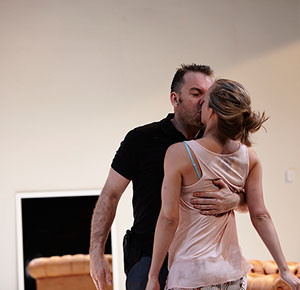
 Left – Brendan Cowell and Taylor Ferguson. Cover – Brendan Cowell and Blazey Best. Photos – Ellis Parrinder
Belvoir’s production of Miss Julie ranks among the most unsettling productions I have ever seen. Simon Stone’s excellent adaptation stays true to the spirit of Strindberg’s script in many ways, but the modern setting necessitates a rethinking of not only language but social mores and the trappings of class. Letitia Cáceres has directed a scintillating piece of theatre, visceral, intense, and deeply, deeply disturbing.
Stone’s new version of the script translates the issues of class and gender explored by Strindberg and translates them to a modern setting. This Miss Julie (Taylor Ferguson) is the wayward sixteen year old daughter of a politician, hungry for her father’s attention. Jean (Brendan Cowell) is her bodyguard, while his fiancée Christine (Blazey Best) is the cook. They are the closest thing that Julie has to parents, and yet the relationship between them all is something far more dark and twisted. Julie dreams of escaping her gilded cage, so brilliantly literalised in the second act motif of the birdcage and the murdered bird. When she describes Jean’s extreme childhood poverty as “an experience”, her naïveté is palpable. While she has exoticised and eroticised poverty, Jean has done the same to power, social standing, and notions of “class”. He dreams of being part of the nouveau riche, and as we realise (horribly) in the second act, he is willing to be ruthless and selfish to achieve his dreams of becoming more than he is.
At the centre of this show is the transgressive sexual relationship between Julie and Jean, which contravenes all the boundaries of propriety. The sense of sexual exploitation which existed in Strindberg’s original has been heightened: not only is Julie naive, she is sixteen years old. She may have the power over Jean in terms of class (power she takes perverse delight in wielding in the first act), but his greater sexual experience, as well as the fact he is an adult, places him in a truly uncomfortable position of power over her. Although she makes advances towards Jean, Ferguson’s Julie is not some teenage temptress (an archetype so often relied on in the literary canon), but a vulnerable, lonely, and curious girl, who is overwhelmed by her own feelings, something Cowell’s Jean exploits more and more explicitly as the play develops. It would be fascinating to see a Marxist critique of both this show, charting the negotiations of power and who wields it between these two protagonists. Does Julie’s class privilege trump Jean’s gender privilege? How does this change when they have sex (Jean deflowers Julie, adding a whole new power dynamic to their sexual relationship)? And does power, at the end of the day, grow out of the barrel of a gun?
Stone and Cáceres’ version of this play updates the dynamic between Julie and Jean brilliantly. I was less convinced when it came to the update of Christine. Blazey Best does a great job at making Christine’s journey very believable, but I found her second act actions a little hard to reconcile, particularly at first. Was she really prepared to marry Jean and start a family, knowing what he had done? really prepared to write off his relationship with Julie as an aberration and pretend it never happened? I can understand her wanting to pretend nothing had happened for Julie’s sake, but the fact she was willing to cover for Jean did not ring true for me. At one point, she brings him money and tells him it’s in the car. Personally, I was hoping she was wearing a wire and the whole thing was some elaborate police sting operation.
The one way in which this play radically diverges from the original is in the ending. I won’t spoil it for you, but the person who dies at the end of Strindberg’s play is not the one that dies here. Personally, I liked the change. In her director’s notes in the program, Letitia Cáceres writes about how difficult it was for her, as a feminist director, to come to terms with the misogyny of Miss Julie. While this show is definitely not a feminist fairytale and it does not end well for anyone, the ending of this version is nowhere near as harrowingly misogynist as Strindberg’s: the idea that having sex is something for which women should automatically be punished is nowhere near as pronounced. (That said, it is still deeply, deeply messed up. Don’t expect to come out of this feeling happy.)
It feels strange to say that I “liked” this show, considering how incredibly disturbing it is. It is not an easy two hours to sit through. But it is brilliant theatre. Stone’s script, Cáceres’ direction, and the excellent performances delivered by Ferguson, Cowell and Best combine to make something remarkable: blackly funny, intensely unsettling, and absolutely gut-wrenching. Don’t miss it.
Belvoir presents
Miss Julie
by Simon Stone after August Strindberg
Director Leticia Cáceres
Venue: Belvoir St Theatre | 25 Belvoir St, Surry Hills
Dates: 24 August – 6 October 2013
Tickets: $65 – $45
Bookings: 02 9699 3444 | belvoir.com.au
Sydney Reviews
Miss Julie | Belvoir
- Details
- Jodi McAlister
Most read Sydney reviews

The Lark | Hey Dowling
Noni Hazlehurst brings Rose and The Lark to colourful and compelling life in this one-woman show.
Pride & Prejudice* (*sort of) | Neil Gooding Productions & Woodward Productions
This rollicking musical take on Jane Austen’s beloved novel is a side-splitting crowd pleaser.
Heartbreak Hotel | EBKM
Heartbreak Hotel invites its audience into an intimate portrait of the universal and isolating experience of heartbreak.
Current | Sydney Dance Company
While Bonachela’s work is, as always, dreamily lovely, for me the highlights were absolutely the three commissioned choreographers: Azzam Mohamed, Jenni Large and Raghav Handa.
The Gospel According to Paul – The Second Coming | Soft Tread Productions
The Gospel According to Paul is meticulously crafted entertainment. It’s uplifting without pulling any punches.
The Gospel According to Paul is meticulously crafted entertainment. It’s uplifting without pulling any punches.

While Bonachela’s work is, as always, dreamily lovely, for me the highlights were absolutely the three commissioned choreographers: Azzam Mohamed, Jenni Large and Raghav Handa.