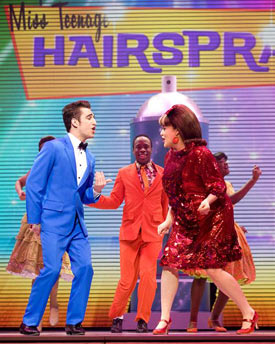
 Left – Jack Chambers and Jaz Flowers. Cover – Jaz Flowers. Photos – David Wyatt
As big Broadway musicals go, Hairspray is a little left field. It is a hit mainstream stage adaptation of the most mainstream of John Waters’ films which, in spite of this, became a cult classic rather than a mainstream hit at the time. Confused yet?
Compared to his infamous early movies such as Pink Flamingos, John Waters’ Hairspray was certainly much less outrageous yet still contained strong commonalities in its campiness and obsession with trash culture. Most importantly, it featured his hometown of Baltimore as not only a setting but an important part of the narrative’s subject matter.
If you are unfamiliar with either Waters’ original, this musical adaptation, or the more recent film based on the musical, the story is fairly simple: Tracy Turnblad is a working-class high school girl in 1963 Baltimore whose dream is to be one of the teenaged celebrity dancers on her favourite TV programme, The Corny Collins Show. She gets her big break and wins the heart of Link, one of the boys on the show, earning her the enmity of his ambitious former girlfriend Amber and her racist stage-mother Velma Von Tussle.
The remainder of the narrative is less about Tracy’s personal travails as it is with her involvement in the push to make The Corny Collins Show racially integrated, as black dancers are only allowed to appear once a month on “Negro Day”, despite the perpetual use of music by black artists. Learning new dances in the African-American neighbourhoods, and with her best friend Penny starting to date Seaweed, the son of an outspoken black DJ, Tracy becomes a passionate opponent of segregation on television, an issue rife in racially-charged ‘60s Baltimore.
Hairspray, in all its incarnations, is an atypical concoction: a seemingly lightweight, energetically camp celebration of retro-kitsch fashion and music surrounding an earnest anti-racism message integral to its Baltimore roots. What is most interesting in its transition from a modest cult film to a huge franchised musical is how this balance of the superficial and the deeper theme translates.
One thing which is clear is that although broadly following the same story, the musical is more than just the film with live singing added – there are actually quite a few adaptational differences. Some characters have been streamlined (e.g. the roles originally played by Mink Stole and Debbie Harry have been conflated), while conversely the narrative has been made more complex, as the original did not really have much of a plot. Thus Tracy’s journey in the musical has more ups and downs, more overt obstacles, more of a “hero’s journey”, if you will.
This is perhaps most evident in the musical’s treatment of Tracy’s weight. In the film, John Waters uses a nicely subversive touch of creating his heroine as a “pleasantly plump” girl (as Tracy puts it), and yet by and large presents this as a non-issue. It is something about which Tracy herself is unselfconscious, boys are shown to find her attractive, and no one other than the cruel Amber ever raises the matter as a negative. In the musical, however, her body image (as well as that of her mother Edna) is presented as something of a self-esteem “issue” which needs to be addressed, albeit in a positive fashion. Similarly, Tracy is immediately lucky in both stardom and love in the film whereas in the musical she must learn new dances after failing her first audition, and also contends with vacillating affections from her beau. Although such changes are commendably designed to make the characters more complex, some of the resulting scenes have an unfortunate tendency to drag.
In essence, the musical presents a much more character-and-plot-driven, more conventional version of the same story, and in some ways this debatably has a softening effect on its anti-racist message. The film, by dint of its minimal plot, actually spends more time on the issue of integration vs. segregation, and features its race relation issues more pervasively, while in the musical they are treated in a clunky and more sporadic fashion.
There are also tonal disjunctions: although both versions portray the prejudiced characters negatively, the film depicts its racists as deeply irrational and slightly comical hysterics, while the musical exaggerates the main racist character of Amber’s mother Velma to the overblown stature of a leering, megalomaniacal Disney villain, resulting in sanitised and generic expressions of her bigotry which seem far less genuine as a result. Apart from one song which overtly references the Civil Rights movement, the treatment of race relations in this musical version seems watered down for the more mainstream Broadway audience.
However, one must also look at this musical as more than just an adaptation: It is an ebullient, attention-grabbing show with a fun vibe, likeable characters, many enjoyable set-pieces and wonderfully over the top exaggerations of ‘60s Americana. Furthermore, it tells a story which is both entertaining and has something to say. Its drawbacks lie in a lack of particularly memorable songs – these original numbers composed for the musical mostly have a somewhat generic “Broadway” sound to them, with the most effective couple of pieces more closely matched in style to the music of the era. The music in general would have been much better if it had been composed more in this vein, which seems an odd stumbling block given the inspiration one would have presumed would be taken from the excellent period soundtrack of the original film.
As a big show it features a large, impressive chorus of talented singers and dancers and often hilarious costumes and stylings, and yet is also quite unconventional in its scenic staging, using a performance area that is almost entirely limited to a cluster of somewhat wobbly platforms which elevate on cue, backed by several large repositionable screens. These screens use digital animation in lieu of physical backdrops or sets, which is quite innovative in effect, and yet something of a double-edged sword. While on the one hand these semi-interactive backgrounds allow for rapid scene transitions and an abundance of locations, it also has the potential to give the show a somewhat cut-price aesthetic, especially when measured against the elaborate scenic design and engineering that goes into the sets of comparable Broadway productions such as Wicked.
The one element of this show which one would be hard pressed to find fault with is its excellent cast. Jack Chambers and Tevin Campbell are charming as the relatively innocuous boyfriends Link and Seaweed, while the far more eccentric roles of Amber and Penny are played to great effect by Renee Armstrong and Esther Hannaford. Cle Morgan does a nice job as activist DJ Motormouth Maybelle, providing some credibility to counterbalance the outrageous villainy of Velma Von Tussle, played with suitably scene-chewing relish by Marney McQueen.
Scott Irwin does well in the somewhat reduced part of host Corny Collins, but it is the pitch-perfect performances of Grant Piro and Trevor Ashley as Wildbur and Edna Turnblad which end up stealing a lot of the best scenes, roles significantly increased from those originally played by Jerry Stiller and Divine. The top-billed Ashley in particular gives quite the star turn, eliciting so many laughs in his drag role as the alternately sweet and thunderingly boisterous Edna that he could very easily have dominated the show.
That is, were it not for the star-making performance delivered by Jaz Flowers as Tracy Turnblad. Although apparently padded up for the role, Flowers is every inch the perfect Tracy, overflowing with the irrepressible pizzazz and charisma so essential to the character. Belting out her songs and busting every move to the fullest, Flowers leads this strong cast very much from the front.
Hairspray is a show not without its flaws, and perhaps more so than one would like from such an expensive, large-scale musical, but to be fair they are generally subtle and subjective. The showstopping finale leaves you on such a high note one is quick to forgive the shortcomings that have preceded it. For most, it will doubtlessly be a thoroughly enjoyable ride, a pastiche of filtered nostalgia celebrating a time and a place few of us ever really experienced, but which is very fun indeed to visit.
HAIRSPRAY THE MUSICAL
Venue: Lyric Theatre, Star City
Dates: From June 2011
Times: Wed–Sat 8pm, Wed 1pm, Sat 2pm, Sun 1pm & 6pm
Duration: 2 hours & 30 minutes including one 20-minute interval
Tickets: $60 – $135
Bookings: ticketmaster.com.au | 1300 795 267
www.hairspraythemusical.com.au