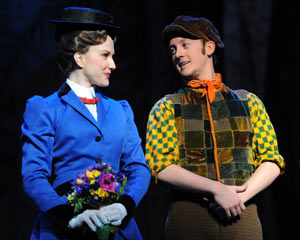
 Left - Verity Hunt-Ballard and Matt Lee. Cover - Verity Hunt-Ballard and cast. Photos - David Wyatt
It is easy to be critical of the various “new” musicals that are based on popular films, pre-existing pop-culture franchises, or even the discography of aging rock bands as all being cynically derivative and cashing in on the notionally “safe” bankability of nostalgia. This can be true… but it doesn’t necessarily mean the final product isn’t any good.
This production most certainly is good. Better than good. Much much better than good. But it is also not really as straightforward an appeal to nostalgia as you might expect. Those expecting a direct recreation of the beloved Julie Andrews Disney film on stage will find they are in for something considerably different. What Cameron Mackintosh and writer Julian Fellowes have done in essence is create a new adaptation that incorporates elements from P. L. Travers’ original books whilst still using other aspects of the film version’s content, including most of its memorable songs, to create a composite that is both delightful and a more interesting and edgy narrative.
This produces an odd effect to anyone familiar with the movie from their childhood (or via their own children) but not exposed to the books, as the broad strokes of the plot are similar and convey the same themes, but it is considerably divergent in its details, with whole scenes, plot threads and “new” characters that are quite dissimilar to those of the film. Mrs. Banks, for example, has an almost unrecognisably different role, a suffragette in the film with little impact on the plot, is portrayed here as a former actress struggling with her husband’s expectations of respectability while trying to help him come to terms with his emotions and sense of social standing. And although similar to his filmic counterpart, Mr. Banks’ motivations and character arc are significantly different, being fleshed out with a backstory that involves his own childhood under the cruel care of nanny Miss Andrew, the anti-Poppins, if you will.
As a result, for those with this likely more common movie-centric frame of reference, the arrival of the highly familiar songs from the film is an almost unexpected delight, as they often crop up in unexpected scenes and quite different contexts than in the movie. Additionally, these original musical numbers by the Sherman Brothers have themselves had something of an overhaul to fit into this version of the narrative, not to mention the fact that there are also new songs and a lot of musical “connective tissue” by George Stiles and Anthony Drewe.
The resulting mix of books and film is ultimately very effective. Whilst perhaps not what some in the audience may have been expecting, this is certainly a rather fine “new” musical, with the additional music integrating very well with the treasured old songs, and this version of the plot and characters producing, quite frankly, a more cohesive and emotionally satisfying narrative, especially regarding the far more fleshed-out versions of Mr. and Mrs. Banks. The story is, after all, not so much about Mary Poppins the magical nanny teaching the disobedient Banks children to behave, as it is her indirectly teaching their parents, particularly the patriarch, to embrace the inner child and become better parents and spouses as a result. It is a tale of familial reconciliation that is much better served by having more fully rounded characterisations with which to create drama.
The production values are superb. Bob Crowley’s set design alone is stunning, with a multitude of different backdrops zipping up and down from the fly-tower, best exemplified by the impressive set of the Banks family’s house at No. 17 Cherry Tree Lane, which features a facade which literally unfolds like a children’s pop-up book to reveal the multi-levelled interior and then spins around and does the same for the kitchen at the back. Indeed, this picture-book aesthetic is evident in much of the design, giving the scenery a hint of pantomime and storybook illustrations without ever seeming cheap or unsophisticated. One backdrop creating Mr. Banks’ job at the, well, the bank, created such an overwhelmingly vertiginous effect simply through the use of perspective that it was positively magical.
Speaking of magic, the production makes excellent use of its many special effects. Aside from the somewhat visible wire-rig that allows Poppins to fly with her umbrella, the show is peppered with some very impressive examples of illusionism and stage-magic, with seemingly impossible moments such as the nanny pulling a whole hatstand out of her TARDIS-like carpetbag live onstage, with no obvious clues to how the trick is performed.
The choreography was also impressive, with some ebullient, showstopping dancing in several of the songs… although I must confess that I was slightly disappointed by the execution of Step in Time, the famous rooftop number with the horde of chimneysweeps. This is an unfortunate, although perhaps inevitably unfavourable comparison when judging it against its cinematic counterpart, surely one of the most thrilling dance numbers in any movie musical ever made, and filmed in such a way as to be impossible to reproduce onstage.
If it seems unfair to be constantly comparing this to the much-loved children’s film, it is something the production has brought on itself for better or worse, having clearly cultivated the nostalgic drawcard of the movie by using its songs and even replicating many of the title character’s costumes rather than choosing more original designs. Given just how different the plot is perhaps helps to insulate the stage version from an excess of these direct comparisons in the audience’s mind, but to some extent they are also quite unavoidable.
On this note, one can’t discuss this production without heaping praise on Verity Hunt-Ballard, the relative unknown who has wonderfully filled the boots of Mary Poppins with boundless talent and charisma. And yet, it has to be said, she projects a rather uncanny resonance of Julie Andrew’s film portrayal, helped in no small part by the practically perfect duplication of Andrew’s look through costume, hair and makeup. This is by no means a criticism per se, indeed for many it will be an absolute boon, but one did have the sense (at least sitting in the back-row press seats, squinting through opera glasses) that it was as if the film character had stepped off the celluloid and onto the stage. This is, in its way, quite an achievement, and yet given how different from the film this production already is in many other ways, it seemed almost a shame to not allow the role to take on a slightly more unique manifestation for the stage version, especially given Hunt-Ballard’s clearly abundant talent as a performer.
This near-excess of filmic verisimilitude for Mary Poppins herself was, perhaps in part, at fault for the much reduced impact that the Bert character had in this rendition. Although clearly intended as being similarly identical to the film version, Matt Lee’s appearance and performance as Bert in no way resembled that of Dick Van Dyke’s, although mercifully lacking his appalling faux-Cockney accent. This may seem oddly hypocritical given the critique of Hunt-Ballard being almost too perfectly like Julie Andrews, yet I couldn’t shake the feeling that this pairing of the leads was somehow disjunctive as a result. Perhaps it was a fault of the casting, but although charming in other roles, here Lee seemed to simply lack the necessary charisma to pull off the character who is second only to Poppins herself in his itinerant wisdom and magical abilities.
The rest of the large ensemble cast was excellent bar none, with the always wonderful Marina Prior doing a great job in the expanded role of Mrs. Banks, opposite the terrific Philip Quast portraying Mr. Banks’ transition from curmudgeonly conservatism, through to despair, and then reborn with a newly childlike zest for life and family. Sally-Anne Upton was very memorable as the boisterous cook Mrs. Brill, Leah Howard brought a lot to the “new” character of Mrs. Corry, and Anna-Lee Robertson (filling in for Judi Connelli) portrayed the villainous Miss Andrew with suitably vaudevillian gusto.
Although not without a few minor weak points that one may quibble over, Cameron Mackintosh’s local transfer of Mary Poppins the musical is an absolute delight. While a healthy dose of nostalgia will certainly enhance the experience, it is a genuinely very solid piece of musical theatre in its own right, well-crafted and filled with charm, magic, and joy. One can’t help but say that it is, in a word – a very special word – SUPERCALIFRAGILISTICEXPIALIDOCIOUS!
Disney and Cameron Mackintosh present
MARY POPPINS
The Musical
Venue: Capitol Theatre, 13 Campbell Street, Haymarket NSW
Dates: Now playing – currently on sale until 28 August, 2011
Times: Wednesday – Saturday 8pm, Sunday 6.30pm
Matinees: Wednesday 1pm , Saturday 2pm, Sunday 1pm
Tickets: $90 – $132.50
Bookings: Ticketmaster 1300 55 88 78