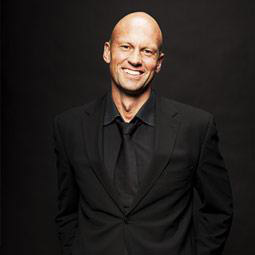
 Left - Teddy Tahu Rhodes. Photo - Cal Crary
The overt thread drawing this very varied and interesting program together was songs, with and without words. But my attention was immediately caught by another theme, that of arrangement or transcription. The only piece on the program that was performed in its original scoring was the slightest, Robert Saxton’s Birthday Piece for Richard Rodney Bennett’s 50th birthday, a piece whose frenetic activity seemed to mirror the amazingly versatile productivity, as composer and pianist, of its dedicatee. All the other five pieces were arrangements of various kinds.
I like arrangements. From Jacques Loussier’s jazzy Bach of the 60s to Genevieve Lacey’s extraordinary transcriptions for recorder, they seem to me to address the question, what if? The ACO began and ended this concert with two arrangements which were exact opposites of each other. In the first, the famous Adagietto from Mahler’s 5th symphony, the seventeen strings plus harp played music imagined for four times as many players, whereas in the final piece the 17 strings were themselves four times the number Mendelssohn imagined for a string quartet. Both performances offered revelations. The Mahler had an intimacy of actual sound which was deeply in accord with the fact that Mahler sent the piece to Alma as a love-letter two months before their marriage – it hovered on a knife-edge of fragile intensity which only the extreme control of every member of the ensemble prevented from disintegrating. This doesn’t happen when 60 strings play it – there is a deep comfort in the lush sound a big string orchestra makes, however emotional the reading of the conductor. Tognetti led a slow tempo that was just, just, sustainable with so few strings, and again came within a hairsbreadth of collapsing, but didn’t. Mendelssohn’s D major string quartet, often described as orchestral in textures, gained in variety of texture and dynamics – obviously 17 instruments can play louder than 4, but it is also true that they can play softer, just as a big chorus can sound softer than a chamber choir. When, in the middle two movements, the texture was reduced to an actual string quartet, I had the sense of seeing through a window into the purer, but less interesting, original.
Teddy Tahu Rhodes reminded me of the great British tenor Gerald English, with whom I had the privilege of working for many years, in his performance demeanour. Disarmingly relaxed yet consummately professional, he sat on a bar-stool and rotated it from time to time to look at the players behind him – and at the end of the performance he was perfectly happy to cart it offstage himself. When he stood up, he altered his playful, provocative engagement with the audience to a commanding, sometimes frightening, presence. He used both styles in his rendering of Rodney Bennett’s Songs before sleep, settings of six English nursery rhymes from the 18th and 19th centuries, many with texts we would hardly consider sleep-inducing for children. ‘[Bonaparte] will beat you, beat you all to pulp [if you’re naughty] and he’ll eat you, eat you snap snap snap’. Well, it’s not my parenting style... Tahu Rhodes sang them with great animation, interacting constantly with the strings in an arrangement by Rodney Bennett himself.
After interval he sang an arrangement by Tognetti of Beethoven’s song cycle An die ferne Geliebte. His voice was just gorgeous in this, and the performance came across as deeply heartfelt. Tognetti’s orchestration of the original piano part worked very well, though the entry of the harp in the fourth song was a bit of a surprise – and yet it was a little like the moments of string quartet in the Mendelssohn I mentioned – the harp, being much closer to a piano than the strings, reminded one of the original strongly.
Perhaps the arrangement I found the least satisfactory was the Prokoviev Five Melodies. Prokoviev wrote them first for voice (without words) and piano, and then for violin and piano. Tognetti’s arrangement for violin and string orchestra deprived the piece of the timbral contrast inherent in both of Prokoviev’s versions, and although Tognetti played divinely (he always does) I found the sparkle and freshness of the piano versions missing. But what a minor quibble that remark is...the concert was a series of different, always interesting pleasures, the performances of which were always outstanding. The ACO is an orchestra of which the nation can be justly proud.
Teddy Tahu Rhodes with the Australian Chamber Orchestra
Venue: Concert Hall, Sydney Opera House, New South Wales
Date: Sunday, 13 February, 2011
Tickets: $45-$119
Bookings: (02) 9250 7777 | www.aco.com.au
Sydney Reviews
Teddy Tahu Rhodes with the Australian Chamber Orchestra
- Details
- Nicholas Routley
Most read Sydney reviews

Dancing at Lughnasa | New Theatre
A gifted embroider of words, Friel combines soft lyricism and hard meaning in his play, a tragical comical historical pastoral on a spree and spoiling for a spirited spar.
Stage Kiss | New Theatre
There’s a palpable playfulness to these performances, disciplined, drilled and delightful. There’s fire, bite and fun and lots of kissing.
The First Murder | Pinchgut Opera
In the care of Pinchgut Opera’s director, Erin Helyard, this music, formulaic as it indeed is in some respects, sprang off the page into an experience rich in emotions.
My Brilliant Career | Sydney Theatre Company
Based on an Australian literature classic, My Brilliant Career is destined to become an Australian theatrical classic.
Sistren | Griffin Theatre Company
Iolanthe and Janet Anderson work in cosmic, comedic accord, characterisation charismatic, timing impeccable, delivery precise, together a tour de force that ascends the cliché.
More from this author
The First Murder | Pinchgut Opera
In the care of Pinchgut Opera’s director, Erin Helyard, this music, formulaic as it indeed...Messa da Requiem | Queensland Ballet
Messa da Requiem was a quite stunning way to inaugurate the new auditorium.Ensemble Pygmalion | 2026 Adelaide Festival
There is no doubt that the three programs presented by the Ensemble Pygmalion were the sen...Mary said what she said | 2026 Adelaide Festival
Going from that show to Mary said what she said was like going from a Mozart piano concert...Marwood and Mustonen | 2026 Adelaide Festival
The whole work is a testament to Shostakovich’s constant battle with the thought police of...
To Shakespeare’s text be true is the obvious goal here, and writer, director and actor have each scored.
Blind faith and rational belief are always sparring partners in dramatic conflict and so it is here with the power play tinged with superstition and salaciousness.