Sydney Reviews
A la francaise | Music Illawarra
- Details
- lloyd bradford (brad) syke
I adore the Sydney Opera House. Its programmes. The companies which frequent it. But sometimes the choked big-city aggravations of making it to performances there compromise, or even threaten to outweigh, the pleasures of attendance.
Not so in Wollongong. I know what you're thinking. Wollongong?! Cultural desert, beset by industrial pollution, hoons, bogans, mullets (in and out of watercourses), burning rubber and testosterone-fuelled antisocial behaviour. All probably true. But scratch the surface of almost any town or city and you'll uncover an arts milieu. Even Wollongong. There's the excellent IPAC (Illawarra Performing Arts Centre) & city gallery, for example. Excellent by any standard. Elena Kats-Chernin, I believe, resides there. As does a broad artistic community, particularly in the city's northern reaches. Dancers; rock musos; you name it.
And there's Music Illawarra. An amateur music club that reflects high, if not the highest, professional standards and an unmatched level of passionate commitment. Its venue, on an unseasonably clement Sunday afternoon is St. Mary's Star Of The Sea secondary college for girls. A school-hall it may be, but the acoustics seem fine and conducive to a presentation of fine classical music. And we were able to walk there, at a leisurely pace, from the northern suburb where we were staying. In the glorious sunshine. Along the glorious coastline. With the glorious escarpment behind. Not traffic. No parking problems. No throngs. No real aggravation.
Peter Wouters presides over the club and, as well as demonstrating his prodigious skills as flautist, MC'd, having gone to considerable lengths to prepare program notes which contextualised and very much enriched the proceedings, an afternoon of sublime, complementary French music, for piano, flutes, voice and 'cello, which began with a sonata (arguably the vaguest of all musical terms); Blavet's fourth (otherwise known as La Lumagne), for flute, featuring four movements.
Michel Blavet was himself a flute virtuoso and, much to the chagrin of lesser contemporaries, I'll bet, much resented for the fact he could play virtually every other instrument and, to add insult to injury, was self-taught. He was no slouch on bassoon, either, apparently. He sounds like an heroic compelling character; the archetypal self-made man since, as the son of a turner (learning and practicing that trade himself), he rose to become the pre-eminent flautist of the first half of the 18th-century. (And this long before Latham's ladder of opportunity.) One or more of his peers testified to his ongoing humility and another affecting biographical note is his determination to compose specifically for amateurs, by writing in the easiest keys. Egalitarianism in rarefied musical circles makes a welcome change from sniffy elitism.
Musically, in the first half of the 21st century, it seems to me Suzanne Cowan fills the breach, with impeccable intonation and an elegant tone. Having graduated from Sydney's conservatorium and distinguished herself as a soloist with both the SBS Youth Orchestra and Australian Wind Orchestra, she is now conferring her skills and experience at Wollongong's con and other institutions. She's also principal flautist with the Wollongong Symphony (yes, there is one), has toured internationally, recorded and been broadcast on ABC Classic FM. No wonder. Her playing reflects a deep longing for good music, underpinned by technical precision. With such a fulsome professional career, there's no obligation incumbent upon her to augment it with these amateur excursions, so there could hardly be any better testament to her sincere attachment to it. And David Vance, throughout the afternoon, provided flawlessly sympathetic piano accompaniment.
Lisa Nolan blessed us with four songs from Faure's L'horizon Chimerique, from as late as 1921; a setting for corresponding poems by Jean de la Ville de Mirmont. Faure has eloquently captured the latter's poignant postwar mood of farewells and loss (Mirmont, still young, was killed during WW1) and the music is as redolent of the sea as a freshly-shucked oyster. Nolan presents with confidence and a nuanced sensitivity to the fragile beauty of these short pieces which, taken together, prove a quintessential evocation of the qualities and characteristics of the romantic period. Nolan's distinctions, of course, include qualifications from the Royal School of Music and Trinity College. She's studied at the Sorbonne, spent several years in OA's chorus and a couple with the Song Company. Now, thankfully, she too is serving to pass on her considerable expertise, via 'the gong's con.
Without betraying the ages of the aformentioned women, suffice to say flautist Gianna Cheung is somewhat their junior. I'm no expert, but I'd guess, maybe, 8. Regardless, even judged without deference to her age, it would be difficult indeed to find any intrinsic fault with her rendition of three of Jules Mouquet's Cinq Pieces Breves. She might yet have something to learn about feeling, colour and character, and might've ideally been a little less anxious to complete the task set, but even at this tender age her technical prowess is virtually second-to-none. A prodigy, much like Blavet. Debussy might've accrued most of the glory, but Blavet is no understudy: his chamber works are not only creditable, but beautiful with, for mine, a (sometimes) delicately Oriental sensibility.
Speaking of prodigies (he's been fluting since the age of six or seven) Peter Wouters joined Cowan to present two of the most challenging and rewarding works for flute, in Gaubert's Divertissement Grec and Delibes' (thanks to the mad genius of Malcolm McLaren) BA-corrupted Flower Duet, from Lakme. Belgium's loss is Australia's gain. Flute duets of this calibre are no mean feat to pull off and, since these were impossible to pick holes in, it's a tribute to both of these worldclass instrumentalists. Wollongong, I'm sure, barely knows what it's got.
The other virtuoso to grace this humble stage was intense cellist, Ilir Merxhushi, who took the concert to interval with a quite spectacularly impassioned reading of Ravel's Pavane. (The fact Ravel studied composition with Faure is a guide to just how carefully considered this balanced programme was. Wouters' anecdote about Ravel's near-contempt for his inescapable Bolero was especially piquant: apparently, Ravel described it as 'a work for orchestra, without music'; certainly, it's reasonable to assert this Pavane as a subtler work of superior taste.)
And to think, this was but the first half!
For a gold coin, you even get afternoon tea (and it's quite a spread), including a specially made, iced and decorated sponge, donated in honour of Music Illawarra. Now that's love. The true spirit of amateurism. In the true sense of the term.
Music Illawarra presents
A la francaise
Venue: St Mary's College, 15 Harbour Street, Wollongong
Date/Time: Sunday, 22nd August, 2pm
Tickets: $15 | $10 concession | $40 family of 2 adults and 2 children
Visit: www.musicillawarra.org.au
Most read Sydney reviews

Dancing at Lughnasa | New Theatre
A gifted embroider of words, Friel combines soft lyricism and hard meaning in his play, a tragical comical historical pastoral on a spree and spoiling for a spirited spar.
Stage Kiss | New Theatre
There’s a palpable playfulness to these performances, disciplined, drilled and delightful. There’s fire, bite and fun and lots of kissing.
My Brilliant Career | Sydney Theatre Company
Based on an Australian literature classic, My Brilliant Career is destined to become an Australian theatrical classic.
Sistren | Griffin Theatre Company
Iolanthe and Janet Anderson work in cosmic, comedic accord, characterisation charismatic, timing impeccable, delivery precise, together a tour de force that ascends the cliché.
Anastasia – The Broadway Musical
Anastasia is a spectacle and the technical prowess is spectacular.
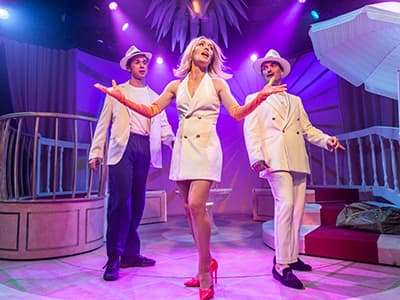
Unabashedly and unapologetically entertaining, Dirty Rotten Scoundrels delights in its hoax hokum, a whimsical hustle of musical comedy bustle.
In the care of Pinchgut Opera’s director, Erin Helyard, this music, formulaic as it indeed is in some respects, sprang off the page into an experience rich in emotions.