 J. M. Barrie. Ring a bell? Peter Pan. But proud Scot, Sir James Matthew Barrie was a playwright, as well as author. Mary Rose, which dates back as far as 1919, has proved a rather under-produced play, given its originality and efficacy as a ghost story. (In fact, I feel a screenplay coming on.) As with Pan, which Barrie based on his friends, Mary Rose has some eery resonance with the dramatist's own life. When he was just 6, his brother, David, died, on the eve of his 14th birthday. Very much the favourite of their mother, he could never be replaced, in her affections, by the surviving son, despite valiant and desperate efforts, such as wearing David's clothes. Hence the theme of the lost child in a number of Barrie's works.
The indefatigable Roz Riley, resident director with Factory Space, has breathed new life into the play. While succumbing to her penchant for classical background music just a little too often, and while I was sorely tempted to spring from my chair to instruct the actors (especially in Act 1) to cast off a certain sluggishness of delivery, Riley has assembled possibly her most even and cohesive cast to date, led by Lara Dignam, as Mary Rose Moorland, who exquisitely communicates a sense of innocence and wonderment becoming of an eternal child.
Richard Hilliar is in fine fettle as her husband, Simon Blake, while Steve Bourke plays the two ages of his character (20 years apart) with great craft & empathy. Alison Albany is his match, literally and otherwise, as his upright wife.
Xavier Masson-Leach took a little while, perhaps, to get into full stride, as Harry Blake, but hit the mark when he did (besides, this was opening night). Family friend and parson, Mr Amy, was convincing, thanks to Leof Kingsford-Smith. The Rowan and The Fir, who bring new meaning, or old, to the secret life of plants, played by Lana Kershaw & Brinley Meyer, were thoroughly inveigling. Sam Rushton, with his flawless brogue, is particularly delightful, as quintessential Scotsman, Cameron.
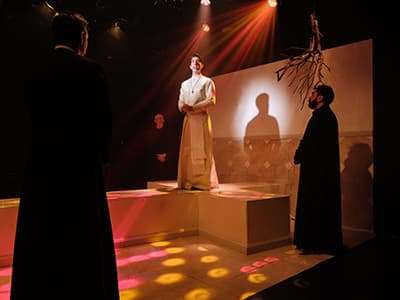
Aside from a pesky drape, and a dress snagged on a trunk (spontaneously saved by Hilliar's ad libbing), stage management, by Lindsay Walton was smooth, Russ Fitzgibbon's original music was just the ticket, while Mitch McDermott's production design left something to be desired. A couple of spray-painted branches, sporting a solitary apple, poking up in front of the stage, made for a lame and laughable fruit-tree. Theatre of the mind would've sufficed, and served better. Star Of The Sea is a fine theatre, with a large, deep stage, that was poorly utilised: a cosier ambience was called for in the many housebound scenes, while greater expanse might've been utilised for the haunting atmosphere of the island that likes to be visited. Marisa Newnes' costumes might benefit from better fittings, but the designs are outstandingly creative, attractive and well-researched, in terms of their evocation of early 20th-century fashion. Similarly, Nina Santucci's hair styling deserves credit. Lighting design, by Taylor Allen, erred on the side of distracting overkill, at times, and might've benefited from an eerier state, not least on the fateful island.
The play is a long one, at around two-and-a-half hours and, though a radical suggestion, I think the epilogue could be truncated, or even dispensed with altogether, for a more modern approach. Dialogue cuts could be made elsewhere, too, since the highly-mannered conversational style can tend to create drag on slippery, digital attention-spans. Still and all, much of Barrie's writing holds up timelessly. Alongside rather weighty themes, Barrie very adeptly interpolates humour: self-mocking ethnic and cultural introspection, via Cameron; a delicious dig at the English; affectionate parody of the nature of aging; and a surprising seasoning insofar as caustic commentary on mere malehood (Mrs Moorland is endowed with a biting line about men not entering a second childhood, as they never quite leave the first).
Much has been made of the story of Mary Rose, the girl who vanishes twice. Firstly, when her father leaves her in what he takes to be the safe hands of a Hebridean island, while he fishes around it. While her absence is lengthy and unendurably aggrieving to her parents (as is her second disappearance, as a newlywed, to her adoring husband), little or no time has passed, for her. And she ages not, while all around her do, markedly. There is, surely, much in this, especially for all of us who are on the wrong side of 40, at which age, if not before, one is prone to observe, or palpably experience, some bodily deterioration, but without resort to a mirror, or intensive pathology, may not feel a day over 25. Academically, Mary Rose has been invaluable and iconic in psychoanalytic theory. A number of commentators have speculated on it being an adaptation of the Oedipus myth: Mary Rose's agelessness allows her son to surpass her age, making him ripe to be her lover. She even sits on his knee, albeit in ghostly form. Her disappearances, to take a Jungian tack, are into the realm of the unconscious. Certainly Barrie must've felt as if he'd disappeared, given his mother's failure to elevate herself from the grave of his brother.
Less seems to have been written about the temporal aspects of the work, which came hot on the heels of World War I and its horrendous toll. With so many families afflicted by death and injury, there must've been sore temptation to return to childhood; to repair to an island, though inevitably haunted, as were so many homes, by memory and loss; there was the pining, of men in trenches, for idealised mothers; there was descent into dreams and nightmares, by those pushed to or beyond breaking-point; there were so many disappearances (two in one family was not at all unusual); and there was the dissonance between the returning soldier (still in many ways a boy, even if ruined and traumatised by action, his innocence stripped away, like so much skin) and his family, which had been timelocked, but which seemed so different.
Riley has made an excellent choice in reviving a worthy play which still has much to say and teach. It provokes, discusses and philosophises without ever threatening to be tedious or in any way didactic, or patronising. On the contrary, it uses as its media gentle, knowing humour and richly-realised characters. Director and cast have brought all of its essential qualities to bear, with perspicacity and panache. A better set is all that's needed. Build it and, given smart publicity, they will come. Regardless, you should go.
Factory Space Theatre Company
Mary Rose
by J.M. Barrie
Venue: Star of the Sea Theatre, Cnr of Collingwood Street and Iluka Avenue, Manly.
Dates: 10 - 24 April, 2010
Times: 7:30pm - Thursdays, Fridays and Saturdays
Matinees: 3:00pm - Sun 11th and Sun 18th April
Tickets: $30 / $25
Bookings: 02 9439 1906 | www.factoryspace.org